Nearly ninety years ago, a small collection of alcoholics in New York and Akron began trying to explain something they barely had language for themselves.
They believed they had stumbled onto a way of living that could help people recover from what was then commonly experienced as a seemingly hopeless condition: alcoholism.
Think about the world in which they were writing.
Women had only gained the constitutional right to vote nationally in 1920. Modern trauma theory did not exist. There was no DSM. There was no attachment theory, no PTSD diagnosis, no neuroscience of reward circuitry, no epigenetics, no smartphones, podcasts, social media, or AI. Mass communication largely meant newspapers, magazines and radio. America was emerging from Prohibition and moving toward a world war it had not yet entered.
And somehow, from that world, these alcoholics produced a surprisingly sophisticated description of something we are still trying to understand:
Why does a human being repeatedly return to the very thing that is destroying him?
That question begins before the Twelve Steps ever appear.
Before alcoholism became the problem, it may have been a solution
The Big Book first establishes credibility through Dr. William Silkworth and then gives us a case study: Bill Wilson himself.
Read Bill’s story today through a trauma-informed lens and something interesting happens.
Bill did not possess our vocabulary. He could not write about attachment injury, autonomic regulation, adverse childhood experiences, trauma responses, affect regulation or the neurobiology of addiction.
But he could describe experience.
Loneliness. Restlessness. Ambition. Fear. Disconnection.
And the enormous relief alcohol initially provided.
That distinction matters.
Alcohol did not initially arrive in Bill Wilson’s life solely as a problem.
It worked.
Until it didn’t.
For many people who develop substance use disorders, the substance is initially adaptive. It changes consciousness. It quiets something. It creates belonging. It regulates an intolerable internal state. It provides courage, anesthesia, excitement, sleep, connection or temporary escape.
The visible addiction may therefore be the late-stage problem created by an earlier attempted solution.
That doesn’t excuse addiction.
It helps explain it.
And you cannot intelligently treat something you refuse to understand.
Then comes There Is a Solution
Chapter Two is remarkable because Bill begins not with theology but with people.
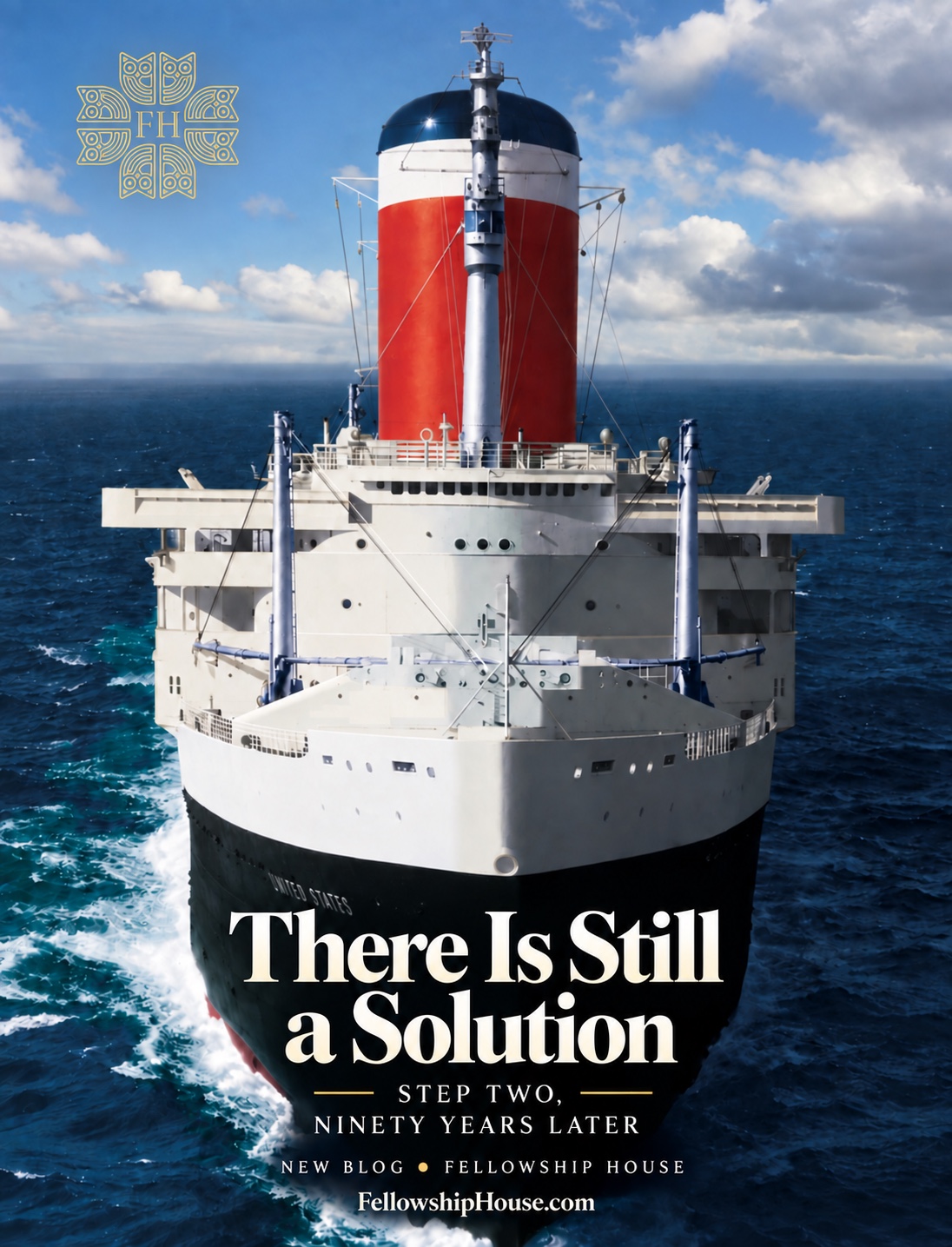
He gives us the image of a great ocean liner.
And it is worth remembering what an ocean liner represented to someone writing in 1939.
Only twenty-seven years earlier, the Titanic had gone down.
I don’t know that Bill Wilson had the Titanic specifically in mind, and I don’t want to put an intention into his writing that we cannot establish. But the image certainly existed within the cultural memory of his generation. The sinking had captivated the world and almost immediately entered newspapers, music, poetry, film and public mythology.
The Titanic represented something larger than transportation. It embodied the extraordinary confidence of industrial modernity: human beings crossing an ocean inside a floating city, with electric lights, grand staircases, dining rooms, engines, steel and luxury arranged into an almost unimaginable technological achievement.
And then it sank.
The First World War followed only two years later.
By 1939, when Alcoholics Anonymous was published, another world war was beginning.
The mythology of inevitable human progress had taken some extraordinary blows.
And aboard those great liners, even while humanity demonstrated its ability to conquer distance and engineer astonishing machines, it carried an ancient hierarchy right onto the ship.
Some people entered grand ballrooms.
Others entered steerage.
The architecture itself told you where you belonged.
Most of us today carry a visual version of this history partly because of James Cameron’s Titanic: chandeliers, formal dinners and sweeping staircases above; crowded immigrant quarters below. Cameron’s film came decades later, of course, but the class division it dramatizes was not invented by Hollywood.
Money, education, occupation, family name and social standing helped determine where people sat and how they were treated.
This is social class.
And class may be one of the most invisible forces organizing human life because the standards of the ruling class can become the standards by which everyone else measures success, respectability and even personal worth.
Capital doesn’t merely distribute money unevenly. It distributes security, opportunity, influence, status and voice.
Class can also become an extraordinarily effective instrument of division. People separated by race, ethnicity, religion and politics can be encouraged to see one another as competitors while barely noticing the economic hierarchy operating above and around them.
Bill Wilson was not writing a Marxist critique of capitalism, and there is no reason to put one in his mouth.
He does something much simpler.
He sinks the ship.
Now the banker, the laborer, the physician, the immigrant, the executive and the unemployed alcoholic are floating in the same ocean.
The hierarchy that organized life aboard the ship suddenly becomes remarkably useless.
Your résumé cannot keep the raft afloat.
Your bank account cannot produce fresh water.
Your social standing cannot rescue the drowning person beside you.
The ocean has very little interest in social class.
That does not mean class suddenly disappears.
Money still matters. Privilege still matters. Access to safety can remain unequal. Human beings do not surrender hierarchy simply because catastrophe has exposed its absurdity. Even at the lifeboats, status, position and access can continue exerting power.
Race does not disappear. Poverty does not disappear. Sexism does not disappear. Historical injustice does not disappear.
But underneath all of it waits a more fundamental fact:
Everybody is on the same sinking ship.
Survival increasingly depends upon other human beings.
The person beside you may possess something you do not: information, courage, strength, a place in a boat, the ability to swim, or simply the willingness to reach backward and pull somebody else forward.
That is what makes Bill’s metaphor so piercing.
He does not have to abolish class philosophically.
He sinks the ship underneath it.
Alcoholism has created an equality nobody aboard the ship would have voluntarily chosen.
The alcoholic who arrived from the captain’s table and the alcoholic who arrived from steerage encounter the same fundamental condition. Their histories remain different. Their suffering is not identical.
But nobody gets a private exemption from reality.
And recovery requires participation with other human beings.
That is where I believe Step Two actually begins.
“Came to believe” starts with came to
The language is worth slowing down.
Came to believe.
Before believe, there is came to.
Where do we come to?
Traditionally, we came to in meetings.
We listened. We read. We called somebody. We watched people who had been as sick as us behave differently.
We heard our own thinking come out of somebody else’s mouth and, sometimes for the first time, recognized how distorted it sounded.
Today, “came to” has another dimension.
We may have to change the information environment surrounding our consciousness.
What are you listening to? What are you watching? What does your phone feed you twelve hours a day? What does your algorithm reward?
Outrage? Fear? Sex? Gambling? Resentment? Status? Consumption? Conspiracy? Comparison?
We talk endlessly about changing people, places and things while carrying a machine in our pocket specifically engineered to learn which stimuli can most reliably capture our attention.
For someone in early recovery, changing an algorithm may now be part of changing an environment.
Because recovery is partly the process of changing what repeatedly enters consciousness.
Thoughts, emotions and behavior
This is one place where the language of Alcoholics Anonymous and the language of the clinical world can meet.
We can simplify an enormously complicated human process into three words:
Thought. Emotion. Behavior.
The actual nervous system is obviously more complicated. Bodies produce sensations before conscious thought. Trauma can activate old alarms before language catches up. Emotions influence thoughts just as thoughts influence emotions.
But in early recovery, this simple model gives us somewhere to interrupt the process.
Consider someone sitting quietly in a chair at Fellowship House.
Nothing dangerous is happening.
But inside his head, everything is happening.
He remembers the breakup. Then the firing. Then his children. Then the money. Then something humiliating he did five years ago. Then his father. Then what his wife said. Then what everybody must think of him. Then the life he was supposed to have by now.
His body has never left the chair.
His nervous system has traveled twenty years.
Rumination and resentment have reconstructed an entire reality.
Then something fascinating happens.
The emotion produced by the thought begins convincing us that the thought must be true.
I feel afraid, therefore danger must be present.
I feel rejected, therefore nobody wants me.
I feel ashamed, therefore I am shameful.
I feel trapped, therefore I need to escape.
The emotion becomes evidence for the thought that helped produce the emotion.
Now behavior begins lining up behind it.
The person starts making frantic phone calls. He wants someone to pick him up from treatment. He suddenly knows why the program is wrong for him. He calls an old girlfriend. He drives past a bar. He contacts somebody he used with.
He begins assembling the conditions under which relapse becomes increasingly likely.
And physically, he may still essentially be sitting in the chair.
This is part of the hypnosis of our own thinking.
An emotion can be absolutely real without being an accurate description of what is happening right now.
That becomes especially important when trauma is involved.
An old alarm can ring in a new room.
So early recovery is partly about learning to notice the sequence before obeying it.
And before we can reliably interrupt it ourselves, we borrow the interruption from other people.
Restored to sanity
This is another phrase that can unnecessarily frighten people.
“Sanity” here does not require us to diagnose someone as insane.
Think of it more practically.
Addiction progressively damages our ability to be reliable reporters of our own reality.
We minimize. We rationalize. We selectively remember. We predict outcomes that repeatedly fail to occur.
We insist that this time will be different while reproducing essentially the same experiment.
We confuse what we desperately want to be true with what the evidence demonstrates is true.
Recovery therefore requires something outside the closed loop of the individual mind.
That is one reason groups are so powerful.
Other people provide friction against distortion.
At Fellowship House, this is one of the reasons we place such importance on developing a shared language of recovery.
A group can say:
Joe, that’s not what happened.
You’re leaving something out.
You’ve said this three times before.
You’re blaming everyone except yourself.
Or occasionally:
Brother, that’s bullshit.
There is an ancient social mechanism operating there:
Ridicule.
That word requires care.
Humiliation is not treatment. Bullying is not therapy. Ridicule coming downward from authority can be cruel, coercive and destructive.
But among genuine equals, humor and affectionate social correction can perform another function entirely.
They can puncture grandiosity.
They can expose contradiction.
They can interrupt cognitive bias.
Anyone who has spent enough time in healthy recovery communities has seen the room erupt in laughter when someone unknowingly describes a form of alcoholic thinking that everyone else recognizes immediately.
The laughter says:
We know this trick. Our minds do it too.
That is very different from shame.
It is reality-testing through belonging.
And eventually something beautiful happens.
The interruption becomes internalized.
What once required another alcoholic sitting across from us becomes a capacity developing inside us.
That’s a thought.
That’s an old alarm.
That’s resentment.
That’s shame.
That feeling is real, but the story I’m attaching to it might not be.
And eventually:
I don’t have to behave because I feel.
Part of recovery is earning back trust in our own mental faculties.
Until then, sometimes we borrow sanity from one another.
Step Two takes up enormous territory
This is something people miss when they reduce Step Two to:
“Do you believe in God?”
That question is almost comically smaller than the territory the Big Book actually explores.
The discussion stretches from There Is a Solution through More About Alcoholism, into We Agnostics and toward How It Works.
Why so much space?
Because before asking someone to trust a solution, you have to establish a shared understanding of the problem.
What actually happens before relapse?
Why does knowledge fail?
Why does intelligence fail?
Why does consequence fail?
Why can someone sincerely swear at 8:00 in the morning that he will never drink again and be drinking at 4:00 that afternoon?
Later researchers and clinicians—from E. M. Jellinek to Terence Gorski and generations of addiction researchers after them—would develop increasingly sophisticated models for progression, relapse and recovery.
But the early recovery movement had already recognized something essential:
The drink is not the entire disorder.
Something precedes it.
Something organizes the return to it.
And something has to change before abstinence becomes durable recovery.
A power greater than myself does not have to violate physics
This is where Step Two becomes much more interesting to me.
A higher power can be understood theologically. For millions of people, it is God.
Fine.
But the genius of recovery is that it does not have to end there.
The group is demonstrably more powerful than the isolated individual.
Language is more powerful than private confusion.
Relationship can alter behavior.
Environment can influence gene expression.
Repeated experience can alter neural pathways.
Belonging can alter what a person believes is possible.
None of those claims require the supernatural.
They require relationship.
So when someone enters Fellowship House convinced that nothing can change, I don’t particularly need him to solve the metaphysics of the universe before lunch.
I need him to entertain one proposition:
Maybe your present understanding of yourself is incomplete.
Maybe something exists outside the closed system that has been producing the same outcome.
Maybe twelve people can see something one frightened person cannot.
Maybe another alcoholic can lend you hope before you possess any of your own.
Maybe trust can precede certainty.
That, to me, is faith in its most useful sense.
Not intellectual submission.
Trust sufficient to conduct the experiment.
The ship is still with us
And perhaps Bill’s ocean liner has acquired another meaning in our own time.
Artificial intelligence may become another enormous rearrangement of the deck.
It could weaken traditional class boundaries by making knowledge, expertise and productive capacity available to people who historically could not afford access to them.
It could also do precisely the opposite: concentrate extraordinary economic and informational power among a relatively small number of institutions and people who own the systems, infrastructure and data.
It may do both.
That question has not been settled.
And many of the people whose lives will be altered by these systems were never meaningfully asked for their consent to the transformation.
Which makes the old recovery insight strangely contemporary.
Healthy Alcoholics Anonymous has practiced, however imperfectly, a radical social proposition for generations:
Your status outside the room does not determine the value of your voice inside it.
The executive can be helped by the laborer.
The physician can be helped by the mechanic.
The wealthy alcoholic may need the wisdom of someone who arrived with nothing.
The person from steerage may know how to survive the wreck.
AA does not prove that social class is unreal. Outside the room, class has material consequences that are painfully real.
It demonstrates something subtler:
Class is a human construction, not a measure of human worth.
And human constructions that appear permanent can become remarkably fragile when the conditions supporting them change.
Technology may rearrange those conditions again.
The question is whether we use that power to build another captain’s table—or recognize, before another ship has to sink, that we were dependent upon one another all along.
Recovery needs a common language
This is why we teach recovery incrementally at Fellowship House.
We are trying to make it hold.
Trauma can be thought of, imperfectly but usefully, as an experience whose signature continues operating after the original danger has passed. Addiction may become one way a person learns to regulate the resulting internal state.
Remove the anesthetic without addressing the wound and we should not be surprised when the organism searches for anesthesia again.
So we develop a vocabulary around trauma, craving, resentment, avoidance, attachment, relapse, agency, acceptance, impermanence, accountability, amends and belonging.
When a community shares language, it gains the ability to examine experience together.
That becomes an operating system for recovery.
Because when language breaks down, shared meaning begins to break down.
When shared meaning breaks down, reality becomes increasingly private.
And addiction thrives in private realities.
Maybe that is why Bill Wilson spent so much of the opening of the Big Book getting us to Step Two.
Before asking us to believe in anything extraordinary, he asks us to consider something much more immediate:
What if I cannot recover entirely inside the same mind that keeps convincing me I don’t need recovery?
Then he puts us on the life raft together.
Captain’s table and steerage.
Rich and poor.
Believer and atheist.
Educated and uneducated.
Different races, histories, classes, religions and wounds.
Traumatized in different ways, carrying different histories, possessing different advantages.
But for this particular voyage, facing the same sea.
Nobody’s status keeps him dry.
And perhaps the beginning of sanity is simply this:
I may not see reality clearly alone.
You may not either.
But together, we might get closer.