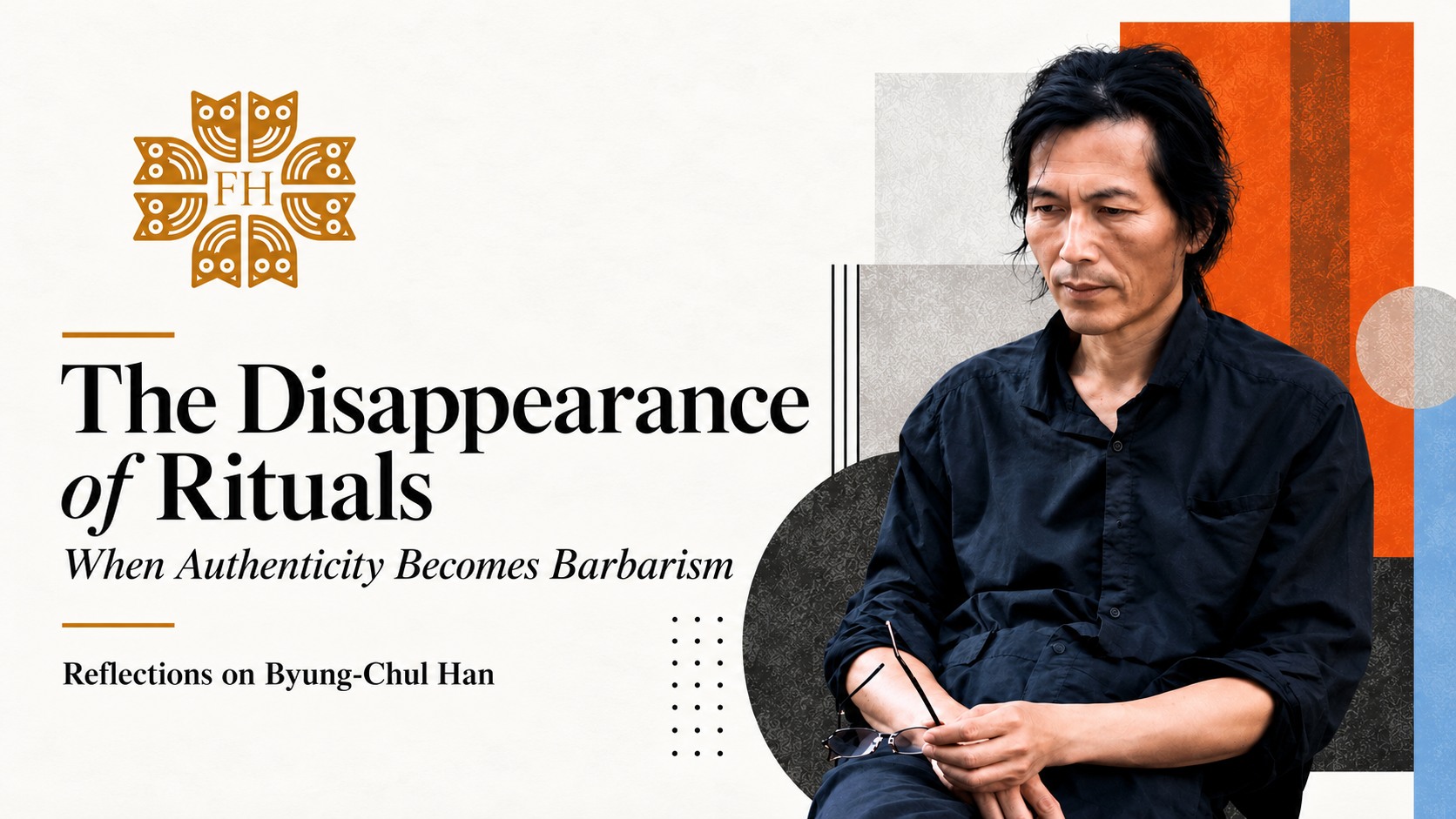
I recently finished The Disappearance of Rituals: A Topology of the Present by philosopher Byung-Chul Han. It's a beautiful, concise, and occasionally unsettling book. One of those rare short works that makes you reconsider things you've been looking at your entire life.
Han argues that modern society is losing its rituals—not simply religious ceremonies or ancient customs, but the repeated gestures, shared language, manners, celebrations, and symbolic practices that give human life continuity.
We have not necessarily become less communicative. Quite the opposite. We communicate constantly. But in doing so, perhaps we have become less connected.
And increasingly, we seem to have mistaken exposure for authenticity.
The Digital Pacifier
Han describes the smartphone as something fundamentally different from the enduring objects that once helped stabilize human experience. A table remains a table. It occupies a place in our lives, accumulating memories and meaning. The smartphone, by contrast, offers an endlessly changing procession of information demanding our attention.
The device remains in our hands, but what it presents never remains still.
I see something resembling a digital pacifier in the early stages of addiction recovery.
At Fellowship House, where we provide treatment for substance use disorders, the smartphone can become a nearly continuous source of stimulation, reassurance, avoidance, and distraction. This is not unique to people with addiction. It is increasingly the condition of modern life.
The person who has spent years attempting to regulate distress through substances may now encounter an entirely different apparatus for avoiding uncomfortable internal states.
A moment of silence becomes an opportunity to scroll. Boredom becomes intolerable. Solitude becomes something to escape.
But boredom is not necessarily pathological. Neither is silence.
Sometimes the ability to remain with oneself, without reaching for immediate relief, is precisely what recovery requires.
When Everything Becomes Production
Han's criticism of capitalism is not limited to the exploitation of labor. He describes a society in which virtually everything becomes an opportunity for production, consumption, measurement, and optimization.
Even rest becomes productive.
We sleep to perform better. We meditate to become more efficient. We exercise to improve our metrics. We turn our hobbies into brands and our private lives into content.
Consider the poetry of the biblical Sabbath. God does not rest on the seventh day merely to improve productivity on the eighth. Rest has meaning in itself.
That distinction seems almost radical today.
I wonder how much of our contemporary exhaustion arises from the inability to experience anything without converting it into an instrument of improvement.
In addiction treatment, we necessarily measure outcomes. Attendance, retention, clinical progress, employment, and sustained recovery matter. They help us evaluate whether our interventions are working.
But a person's life cannot be reduced to a dashboard.
A meaningful conversation, an evening spent in friendship, a moment of forgiveness, or the simple experience of belonging may resist measurement while remaining central to recovery.
There is a danger in confusing what we can count with everything that counts.
The Strange Barbarism of Authenticity
One of Han's most compelling arguments concerns our contemporary obsession with authenticity.
We have become suspicious of manners, ceremony, social roles, and politeness, as though these were necessarily forms of dishonesty.
The modern command is to be completely yourself, reveal everything, express every feeling, and abandon the social conventions that might interfere with your personal truth.
But Han asks us to reconsider the value of appearances, theatricality, and social distance.
Perhaps manners are not merely artificial restrictions on our true selves. Perhaps they are among the practices through which we become more considerate human beings.
There is a difference between honesty and indiscriminate disclosure.
In clinical settings, we sometimes use the informal term trauma dumping to describe overwhelming, poorly contained disclosures of distress. The term itself can be dismissive, and people deserve compassion when sharing painful experiences. Yet the distinction between expression and meaningful processing remains important.
Not every disclosure is healing. Not every audience is prepared to receive it. And not every emotional revelation represents psychological growth.
A therapeutic relationship requires trust, timing, boundaries, and care.
In other words, it requires form.
I find this especially relevant to the explosion of podcasts, personal brands, and the commercialization of psychological language.
There are extraordinary conversations happening in these spaces. Long-form discussions can provide nuance that short media formats rarely accommodate.
But there is also an economy built around the endless public performance of authenticity.
Pain becomes content. Vulnerability becomes identity. Personal history becomes a product.
And the audience, rather than challenging the speaker, can become an echo chamber rewarding increasingly dramatic declarations.
What began as a desire to be understood can become another exercise in narcissism.
Have We Lost the Art of Play?
Han also explores the disappearance of theatricality, ceremony, courtship, and symbolic play.
These practices created a space between immediate impulse and action. They allowed human beings to inhabit roles, experiment with identity, negotiate status, and express conflict through forms that were not simply direct confrontations.
This does not mean that historical rituals were uniformly peaceful or benevolent. Many reinforced hierarchies, exclusion, and violence.
But their symbolic dimensions deserve consideration.
Courtship once involved elaborate conventions of anticipation and uncertainty. Public ceremonies created shared occasions for recognition. Even conflict could be mediated through formal gestures and rules.
Today, much of our communication is stripped of that distance.
We are encouraged to react immediately, disclose everything, and regard restraint as inauthenticity.
Something is lost when every experience must become literal.
Mystery, anticipation, metaphor, and play are not necessarily obstacles to truth.
They may be among the ways human beings learn to approach it.
The Ancient Without the Supernatural
Reading Han made me reflect on some of the decisions we made when establishing Fellowship House.
From its inception, I wanted our organization to draw upon ancient human practices without requiring supernatural beliefs.
Our mandala, with its owls and symbolic geometry, is not simply branding. It is an attempt to create a recognizable language of belonging.
We celebrate graduations. We applaud milestones. We use the familiar language of recovery. We practice meditation, encourage evening reflection, and introduce the moral inventory as a daily exercise in accountability.
Sometimes we burn Nag Champa incense before meditation.
Not because we are practicing Buddhism, but because scent, environment, repetition, and intention can create a meaningful transition from one state of attention to another.
We are setting a stage.
Our therapeutic work also incorporates experiential exercises, role-play, and Gestalt-informed techniques. These allow participants to experiment with perspectives, challenge rigid self-concepts, and encounter parts of themselves that may not emerge through ordinary conversation.
There is something powerful about temporarily stepping into a role.
It can create the distance necessary to see oneself differently.
These practices do not replace evidence-based clinical interventions. Nor should we assume that every ritual has a demonstrated therapeutic effect simply because it feels meaningful.
But they remind us that treatment takes place within a human environment.
And the qualities of that environment matter.
The ceremony of graduation, for example, does more than acknowledge completion of a program.
It allows a person to be witnessed by a community.
For someone whose recent history may be defined by shame, isolation, and repeated disappointment, that recognition can carry extraordinary meaning.
We are not merely reporting progress.
We are celebrating a human being.
Trauma, Identity, and the Limits of Diagnosis
Han's critique also made me think about the extraordinary popularity of trauma as an explanation for contemporary emotional suffering.
I believe trauma-informed care is indispensable to effective addiction treatment. Adverse experiences can profoundly influence emotional regulation, relationships, coping, and vulnerability to substance use.
But trauma is not a universal explanation for every psychological difficulty, nor does every painful experience constitute a traumatic disorder.
The DSM-5-TR recognizes several trauma- and stressor-related diagnoses, including PTSD, acute stress disorder, adjustment disorders, prolonged grief disorder, and others.
Still, diagnostic categories cannot fully describe the complexity of human experience.
There is an enormous difference between understanding trauma clinically and turning it into a cultural shorthand for every discomfort, disappointment, or interpersonal conflict.
We should be careful not to let the popularity of psychological language undermine its precision.
When complicated clinical concepts become slogans, we risk losing the very nuance that makes them useful.
And when trauma becomes the organizing principle of someone's identity, we must be attentive to whether that understanding supports growth or inadvertently reinforces a fixed sense of self.
People are more than what happened to them.
Recovery must leave room for that possibility.
The Circus I Helped Build
I should confess that I'm hardly innocent in any of this.
When MySpace and Facebook first appeared, I was ready to throw a saddle on the whole thing and ride. My personality has always had a flamboyant, occasionally maddening quality, and here was an entirely new theater in which to curate its stranger corners.
I loved the circus of it.
There was playfulness in those early digital spaces. The absurdity, the invention, the opportunity to perform a slightly exaggerated version of yourself. I wasn't necessarily searching for authenticity. I was enjoying the artifice.
Then, slowly, the circus became a marketplace.
Facebook lost some of its original weirdness. The playful performance of identity gave way to increasingly calculated displays of relevance, outrage, and approval.
And then came LinkedIn.
Good God. Even writing the name makes me want to reach for a wastebasket.
Yet I participate.
I understand the necessity of remaining visible, particularly as someone responsible for an organization, its employees, and the people we serve. There is a practical value in communicating our work and maintaining a public presence.
But I can feel the machinery.
I can feel how easily an ordinary thought becomes something to publish, how quickly an experience becomes an opportunity for content, and how subtly the question changes from Was this meaningful? to Will anyone see it?
I've made some deliberate changes. I removed social media applications from my phone. Much of my engagement now happens from a desktop computer, and Fellowship House maintains a more structured publishing schedule. I've become less interested in checking the applause after every performance.
Still, I recognize the impulse.
I am addicted to information. Worse, I am particularly attracted to dreadful information.
There is always another crisis to understand, another political development to investigate, another technological breakthrough suggesting that the world is about to become unrecognizable.
And in the last decade, as political polarization has intensified, the relationship between social media and democracy has become increasingly troubling.
Platforms that reward emotional intensity, speed, and engagement do not necessarily reward deliberation, patience, or truth.
Democracy requires some capacity to inhabit a shared reality. Our digital environments can reward us for retreating into competing versions of one.
Perhaps this is why I've begun imagining a rather peculiar future for myself.
Twenty-four months from now, I sometimes picture owning a flip phone. Maybe there isn't even an internet connection in my house.
It's an amusing fantasy for someone simultaneously fascinated by artificial intelligence and helping develop digital tools for behavioral healthcare.
But perhaps that contradiction is the point.
I don't necessarily want less knowledge. I want more freedom to decide when knowledge deserves my attention.
I want to recover the capacity to inhabit an ordinary afternoon without feeling compelled to investigate the fate of civilization.
There are genuine existential risks confronting humanity, from ecological instability to the uncertain trajectory of increasingly autonomous artificial intelligence. There are also profound challenges facing democratic institutions.
I don't believe we should ignore them.
But I have begun questioning whether my continuous awareness of catastrophe is itself becoming a substitute for meaningful action.
Knowing everything that might go wrong is not the same as participating in what might go right.
Rituals at the Threshold of Artificial Intelligence
Han's book was originally published in German in 2019, before the current explosion of generative artificial intelligence.
That makes his argument particularly interesting today.
We are entering an era in which information, communication, emotional simulation, and personalized interaction can be produced at extraordinary scale.
AI may become immensely valuable in healthcare, education, scientific discovery, and human communication. I am personally interested in developing technologies that support recovery and improve access to care.
But the central question Han raises becomes even more urgent:
Will these technologies strengthen our capacity for human connection, or will they increasingly substitute information for experience?
A system can remind someone to meditate. It can help organize a daily inventory. It can explain the psychological value of a graduation ceremony.
But the ceremony itself remains something different.
It is embodied, communal, imperfect, and shared.
Perhaps the greatest opportunity for AI in behavioral healthcare is not to replace these experiences but to protect the time and resources necessary for them.
Technology should help us become more available to one another, not merely more efficient at avoiding one another.
The Life Happening in the Room
I don't believe we need to resurrect every tradition or romanticize the past.
Many rituals deserved to disappear. Others need to evolve.
And perhaps some rituals have not disappeared at all. They have simply been replaced by new ones: checking notifications, monitoring engagement, performing identity, and seeking reassurance through the endless repetition of digital habits.
The question is whether these rituals create belonging or merely sustain consumption.
For all my interest in philosophy, consciousness, politics, technology, and the future of civilization, I can still find extraordinary meaning sitting in a room with one person struggling with addiction.
One alcoholic. One addict. One human being trying to find a way back into life.
No audience. No algorithm. No optimization.
Just the imperfect ritual of two people speaking honestly to one another.
Perhaps that's where Han's argument becomes most persuasive to me.
The world may be changing faster than our capacity to understand it. But the life we are actually living remains stubbornly local.
It is happening in the room we're in.
And I don't want to miss it while staring at a screen, waiting for the world to end.
Joseph A. Van Wie III is the co-founder and CEO of Fellowship House, a substance use disorder treatment and recovery organization in Northeastern Pennsylvania. He is a Certified Alcohol and Drug Counselor (CADC) and a graduate student in social work at Columbia University.
Book reviewed: Byung-Chul Han, The Disappearance of Rituals: A Topology of the Present, translated by Daniel Steuer, Polity Press, 2020.