

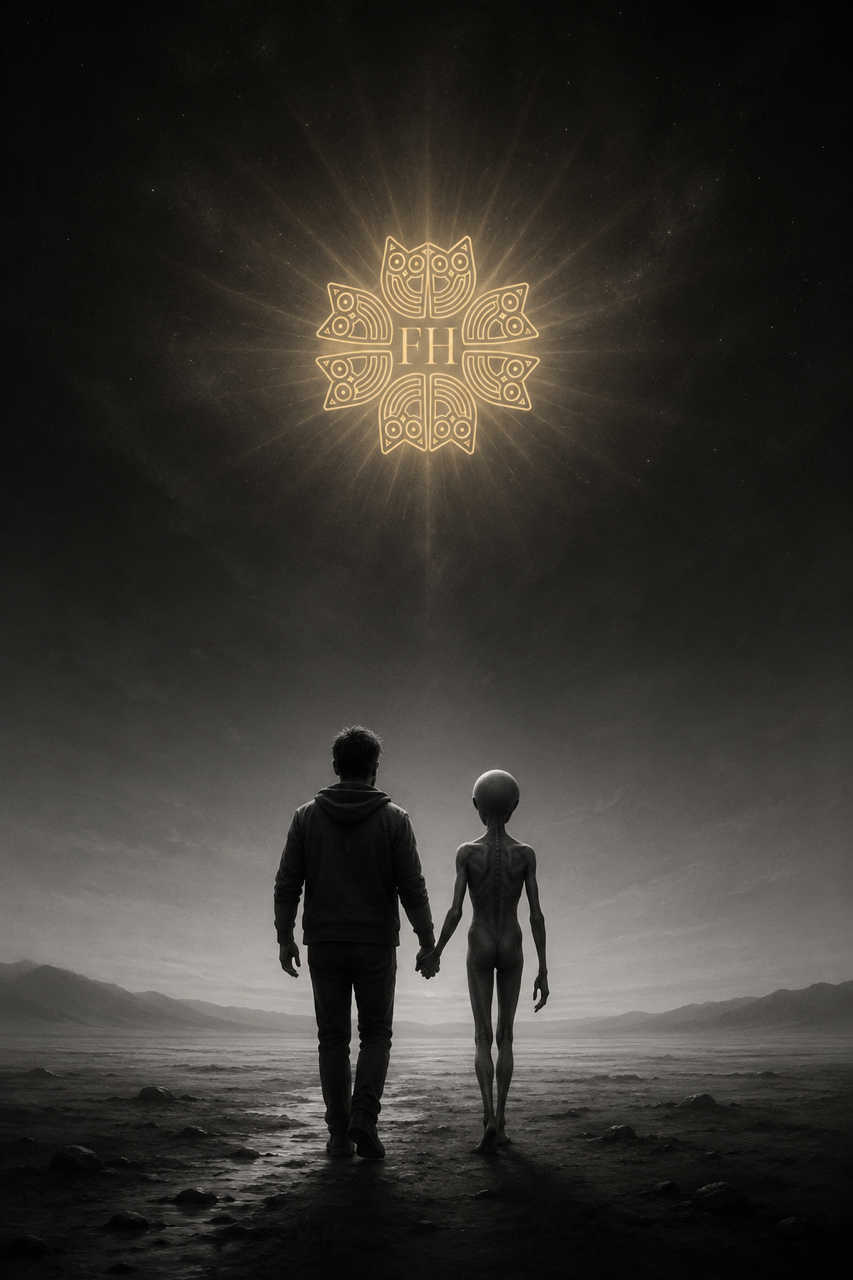
I recently found myself in a conversation about aliens.
Not little green men, exactly. The conversation started with artificial intelligence and eventually wandered toward a question that has fascinated human beings for generations: If intelligent life exists elsewhere, what would actually make it capable of leaving its planet?
Space is profoundly hostile to biology as we understand it. Radiation. Vacuum. Extreme temperatures. Immense distances. The psychological and physical demands of keeping generations of biological organisms alive while traveling between stars seem almost absurd.
It made me wonder whether a truly spacefaring civilization would remain biological at all.
Maybe biological intelligence eventually creates synthetic intelligence because machines are simply better suited to make the journey. Maybe biology is the beginning of intelligence rather than its final form.
Or perhaps there is an even stranger possibility hiding inside that sentence.
Maybe the first alien intelligence wasn’t something that arrived here at all. Maybe it emerged alongside us: language itself. For thousands of years, language required a biological nervous system as its host. It moved from mind to mind through speech, stories, books and eventually digital networks. And now, with artificial intelligence, we may have done something historically peculiar: given language a place to operate untethered from a nervous system.
I don’t mean that literally, or that language is secretly conscious. But the thought is unsettling enough to deserve its own question:
Did we give machines language—or did we finally give language a machine?
That’s a conversation for the next blog.
For now, back to the stars.
There are some wonderfully strange ideas in astronomy that make this thought experiment even more interesting.
One is the von Neumann probe: a hypothetical self-replicating spacecraft. Instead of carrying an entire civilization across the galaxy, you send a machine capable of reaching another solar system, using local materials to reproduce itself, and sending its descendants onward. Even traveling far below the speed of light, replication changes the mathematics enormously. Given enough time, machines could theoretically propagate across enormous portions of a galaxy.
Then there is the Kardashev scale, which imagines civilizations according to the amount of energy they can harness: roughly planetary energy for a Type I civilization, the energy of its star for Type II, and energy on the scale of an entire galaxy for Type III.
And hanging over all of this is the Fermi paradox.
If the universe is so old, contains so many stars, and potentially provides so many opportunities for intelligent life—and if technological civilizations could eventually send machines across astronomical distances—then where is everybody?
It’s a wonderful question precisely because we don’t know the answer.
But another question interests me even more.
What would motivate an advanced civilization to go anywhere in the first place?
Our answer tends to reveal something about ourselves.
Competition and the Stars
We understand competition.
Scarcity produces competition. Competition produces innovation. Nations compete. Companies compete. Economies compete. Wars have accelerated technologies. The space race put human beings on the Moon.
Today, that same machinery is unmistakable in artificial intelligence. Companies compete with companies. Nations worry about other nations. Capital pours into infrastructure because nobody wants to discover that somebody else achieved the next breakthrough first.
Competition moves things.
Pain moves things too.
And this is where my thoughts unexpectedly returned to recovery.
Pain as Fuel
Recovery communities understand pain intimately.
There is an old and often useful proposition underneath much of recovery culture: people change when remaining the same becomes painful enough.
I don’t disagree with it.
Pain changed me.
Consequences changed me. Fear changed me. Loss changed me. The memory of suffering became a kind of muscle memory—an internal signature reminding me where certain choices eventually lead.
But I sometimes wonder whether recovery culture can become too attached to suffering as the necessary engine of transformation.
We can even become strangely Calvinistic about it.
Someone experiences consequences and part of us thinks: Good. Maybe now they’ll learn.
Someone relapses and we begin cataloging the decisions that produced it. Someone is suffering and empathy can quietly become conditional because their pain appears “self-created.”
There is certainly such a thing as accountability. Recovery without accountability quickly becomes sentimentality.
But accountability and compassion are not opposites.
More importantly, even if pain begins transformation, must pain continue powering it forever?
I don’t think it has to.
Competition and Equanimity
This brought me back to the hypothetical civilization looking toward the stars.
We tend to assume that an advanced civilization would expand because it needs something.
Resources.
Territory.
Energy.
Survival.
Dominance.
Maybe that’s because these are the motives we know.
Evolution on Earth gives us plenty of evidence for competition. But it gives us equally remarkable examples of cooperation. Cells organized into organisms. Organisms formed societies. Human beings developed language, culture, institutions and eventually scientific communities in which knowledge could accumulate beyond the lifespan of any individual.
So perhaps the question isn’t competition or harmony.
Perhaps sufficiently advanced systems become capable of cooperating without eliminating difference.
And what if a civilization eventually developed enough stability that scarcity and competition stopped being its primary motivations?
Would it stop progressing?
At first that seems intuitive. If everyone developed perfect equanimity, perhaps everybody would simply sit underneath the extraterrestrial equivalent of a Bodhi tree and nobody would bother building the spaceship.
But I think we’re overlooking another extraordinarily powerful motivation:
curiosity.
Nothing has to be wrong for something to be interesting.
Nothing has to hurt for us to move toward it.
A civilization might cross an ocean—or eventually a solar system—not because it is fleeing suffering or conquering territory, but because there is something on the other side that it desperately wants to understand.
That distinction increasingly matters to me personally.
The Alien Behind My Eyelids
There is another reason aliens have occupied a peculiar corner of my imagination.
For roughly six years, meditation has been part of my life. Occasionally, sitting with my eyes closed, shapes emerge in the darkness.
There may be an utterly ordinary physiological explanation for some of this—the visual noise of a closed eye, pressure, light filtering through an eyelid, the architecture of the eye socket, and a brain doing what brains constantly do: finding recognizable forms in ambiguous sensory information.
But my imagination repeatedly assembled those forms into something strangely consistent.
The skull of a gray alien.
I never needed to decide that it meant anything objectively. That distinction matters to me.
More recently, I completed a course of EMDR therapy, and that old image unexpectedly became useful material to unpack with my therapist.
The alien became a metaphor for a fractured self.
A self that didn’t feel rooted.
Using another metaphorical language—the chakra system—I could describe it as having underdeveloped lower chakras and dramatically overdeveloped upper ones: intellect, abstraction, imagination, spirituality, ideas. I had become extraordinarily comfortable living upward while having much less access to the grounded emotional development underneath it.
I don’t need chakras to be literal anatomical structures for the metaphor to contain useful information.
I don’t need the alien to have been anything other than an image produced by my own mind.
That’s actually the point.
Something can be meaningful without becoming a belief.
Recovery Beyond Escape
Early recovery necessarily contains a lot of movement away from things.
Away from alcohol.
Away from drugs.
Away from chaos.
Away from destructive relationships.
Away from shame.
Away from the person we were becoming.
Pain provides enormous propulsion for that journey.
But eventually there needs to be somewhere to go.
For me, the Steps, cognitive behavioral therapy, EMDR and mindfulness have increasingly offered something beyond symptom management. In different languages, each has helped create a small amount of distance between experience and reaction.
I can observe a thought without immediately obeying it.
I can experience an emotion without making it an instruction.
I can encounter an image without turning it into a religion.
I can notice an old behavioral pattern beginning without necessarily completing it.
That observer position changes the motivational landscape.
Because once I am not spending every moment escaping discomfort, another question becomes available:
What am I curious about?
That’s a very different question from:
What am I afraid of?
Should, Could and Would
Human beings have another peculiar problem.
Language allows us to inhabit realities that don’t exist.
This should have happened.
I could have done that.
They would have treated me differently if…
There is no “should” sitting somewhere in nature. You cannot put one underneath a microscope. Yet the human mind can construct an alternative reality and compare the present moment against it indefinitely.
That ability is enormously useful.
It allows us to plan.
It creates morality.
It allows us to imagine consequences before experiencing them.
It also allows us to torture ourselves with universes that never happened.
Recovery has taught me that I don’t necessarily have to destroy this machinery. I couldn’t if I tried.
I can learn to observe it.
Mindfulness calls me toward awareness.
CBT asks me to examine the thought.
EMDR has allowed old material to be encountered without requiring me to remain trapped inside its original emotional organization.
The Steps repeatedly ask me to surrender the fantasy that reality should reorganize itself around my preferences.
Different traditions. Different conceptual languages. Similar movement.
They create a little space.
And inside that space, curiosity can appear.
A Different Fuel
Perhaps this is one of the transitions of long-term recovery that we don’t discuss enough.
At first:
I don’t want to suffer anymore.
Then:
I don’t want to return to the person I was.
Eventually, perhaps:
I want to see who I can become.
Those statements may produce similar behaviors from the outside.
Someone gets up early.
Someone meditates.
Someone calls another person in recovery.
Someone goes to therapy.
Someone works the Steps.
Someone repairs a relationship.
Someone studies something difficult.
But internally, the fuel has changed.
Fear says: Don’t go backward.
Curiosity says: Let’s see what’s ahead.
That isn’t complacency.
It may actually be a more sustainable form of motivation.
The Signature of Pain
I don’t want to forget pain.
Forgetting it entirely would be foolish.
Pain leaves information behind. I want to retain that information without requiring myself to continually recreate the suffering that produced it.
Maybe that’s one purpose of memory in recovery.
The wound doesn’t have to remain open for the scar to contain information.
And perhaps this is where equanimity becomes misunderstood.
Equanimity isn’t indifference.
It isn’t passivity.
It isn’t the extinguishing of ambition.
It is the possibility of standing somewhere other than inside the immediate demand of every thought and emotion.
From there, motivation doesn’t disappear.
It can become more freely chosen.
Matter Becoming Curious About Matter
Our conversation about extraterrestrial intelligence eventually produced a phrase I haven’t been able to shake:
Matter became curious about matter.
For billions of years, the universe existed without anything on Earth—as far as we know—wondering what it was.
Then chemistry became biology.
Biology developed nervous systems.
Nervous systems developed brains.
Brains developed language.
Language allowed us to imagine things that weren’t present.
Eventually one primate looked upward and asked what those lights were.
Now we’ve built telescopes that can see billions of years into the past. We’ve sent machines beyond the planets. We’ve created artificial systems capable of manipulating language without possessing a human nervous system.
And we’re still asking:
What’s out there?
Maybe curiosity is not secondary to survival.
Maybe, once survival becomes sufficiently secure, curiosity is what intelligence does next.
And perhaps recovery can follow a similar trajectory.
Pain got my attention.
Pain supplied information.
Pain sometimes gave me the willingness to change when nothing else could.
I respect it for that.
But I don’t want pain to remain my primary motivational system forever.
I would rather retain its signature without continually requiring its presence.
As I move toward my fifties, this is where I want to spend more time.
Not becoming less driven.
Not becoming indifferent.
Not replacing one certainty with another.
In fact, almost the opposite.
I want a self that doesn’t require certainty.
A self capable of remaining open.
A self grounded enough to tolerate not knowing.
A self increasingly motivated by curiosity, connection and wonder rather than fear.
There are still relationships to deepen. Things to study. People to serve. Parts of consciousness I don’t understand. Technologies arriving that will radically alter the world. Questions about recovery we haven’t adequately asked. And an incomprehensibly large universe sitting outside the window.
I don’t need to be miserable to investigate any of it.
Maybe that is another stage of recovery:
Not merely learning how to stop running toward the things that destroy us.
Not merely learning how to run away from pain.
But integrating enough of ourselves that we can walk toward the unknown without demanding that the unknown give us certainty.
Maybe the alien was never something I needed to find.
Maybe it was an image that helped me find something much closer to home.
And maybe healing is not finally arriving at an answer.
Maybe it is becoming safe enough within ourselves to look into the enormous darkness, see that we don’t know, and still think:
I wonder what’s over there.
/