

Sometimes I feel like I’ve lived a thousand lives.
Over the last three years, I became almost obsessively focused on AI, its implications, its promise, and its danger. That obsession led me to complete executive leadership training at Massachusetts Institute of Technology focused on AI, machine learning, and safe deployment. What I’m beginning to understand now is the paradox inside all of this.
Living through strange seasons of life, loss, recovery, success, collapse, rebirth, and watching so many friends become memories instead of phone calls, has not made me fearful. Oddly, it has made me more courageous.
I understand substance use disorder deeply. I understand pain, disconnection, trauma, and the invisible economics that shape despair. But more and more, I find myself drawn toward advocating for meaningful regulation of AI, its deployment, its extraction economics, and the social consequences that are rapidly approaching working-class and marginalized communities.
I no longer believe it’s alarmist to say we may be creating something that behaves less like a tool and more like a rival species competing for cognition, labor, attention, meaning, and eventually autonomy itself.
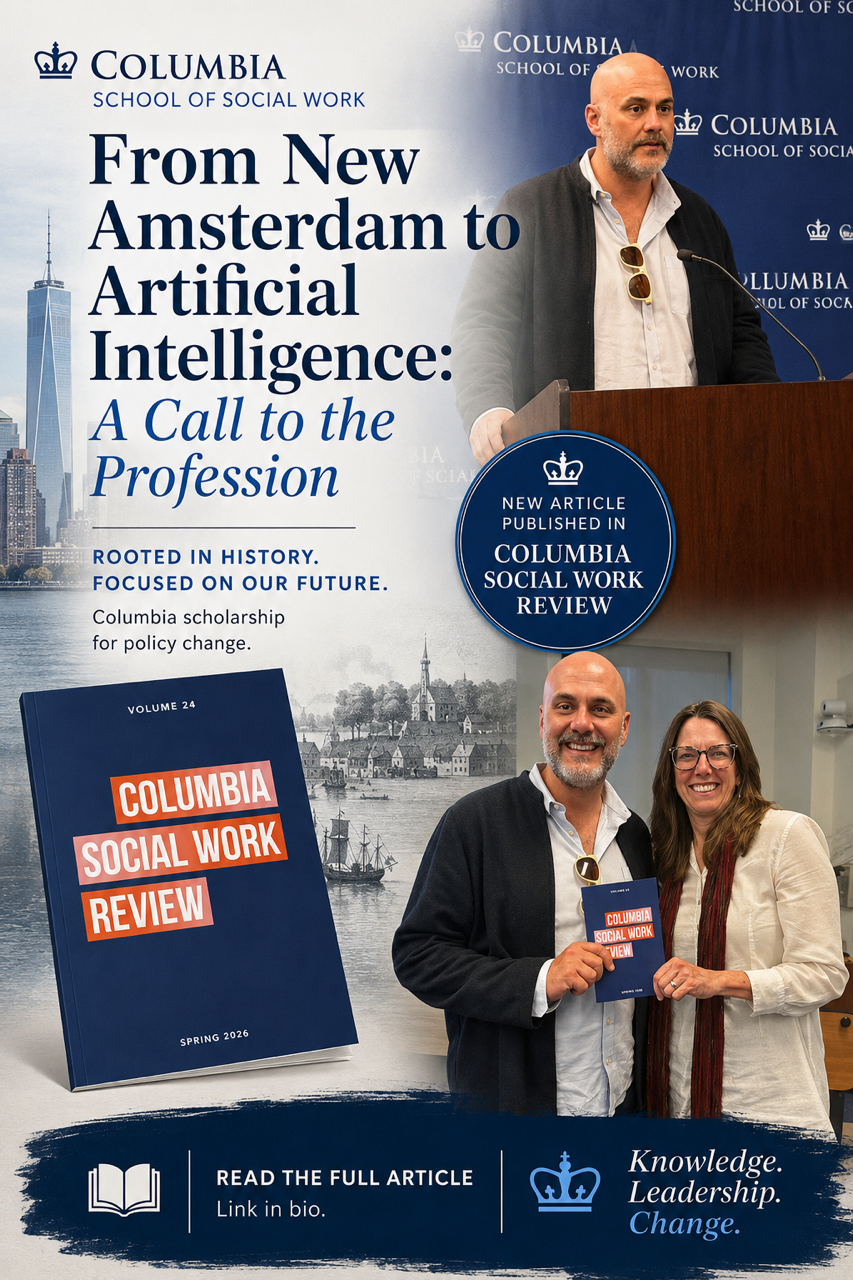
Tonight, I’m deeply grateful to the Columbia University School of Social Work and the Columbia Social Work Review for publishing my piece on AI and the economic consequences emerging technologies may have on marginalized communities.
My time at Columbia has sharpened not only my academic lens, but the way we continue to evolve care at Fellowship House. Through deeper training, rigor, and frameworks like PROP, I’ve gained a stronger understanding of how to better serve Medicaid populations in Pennsylvania and advocate for people too often left without a voice in systems designed around profit instead of people.
We are entering an era where AI will reshape labor, identity, opportunity, and human connection itself. The question is whether we build systems that widen suffering or widen dignity.
Thank you to Columbia for challenging me to think harder, serve better, and remain intellectually honest in this work.
Please take a moment to read my piece in the Columbia Review: ‘From Amsterdam To Artificial Intelligence: A Call To The Profession’
⸻
Author
Joe Van Wie, CADC
CEO and Co-Founder, Fellowship House
M.S.W. Candidate, Columbia University School of Social Work
Executive Leadership Program, MIT Sloan School of Management and MIT Schwarzman College of Computing
Host, AllBetter.fm Podcast