

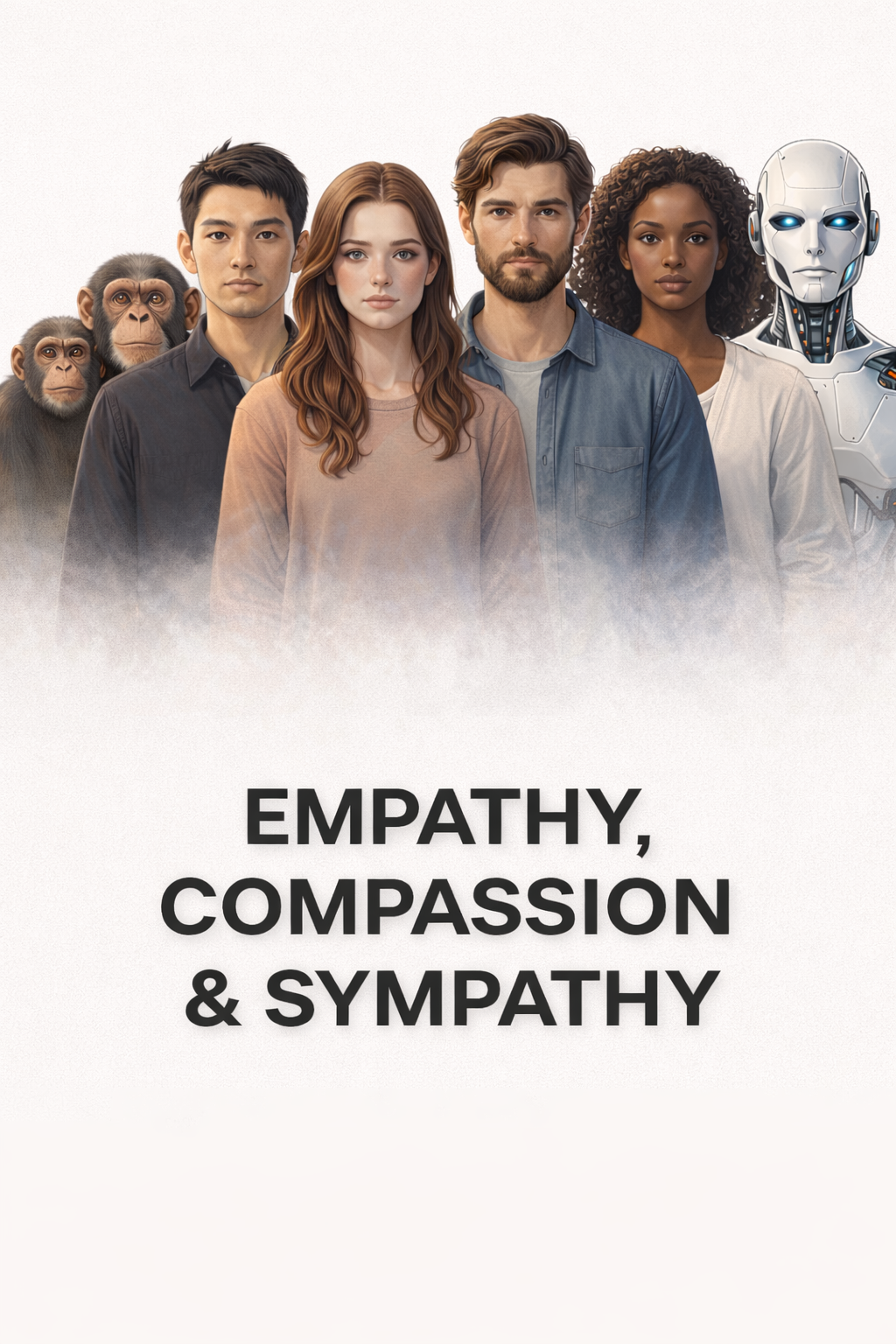
In culture and in clinical settings empathy is often treated as a kind of gift that some people have and others do not. You hear clinicians say someone has natural empathy or that someone just does not get it. But if we step back and ask why empathy exists at all, we land on something far more primal and powerful.
Empathy is not a moral accessory. It is not a personality quirk. It is an evolved biological system that helped mammals survive long before humans invented language, religion, or medicine.
Understanding that changes everything.
⸻
The Mammalian Roots of Empathy
Every mammal that has been studied shows early emotional resonance with others. Newborns cry when other infants cry. Mothers respond to distress without having to think about it. This is not taught. It is wired.
This resonance supports survival. A group that feels together can act together. Individuals who can sense distress, fear, or safety in others have a much higher chance of surviving than those who cannot.
Neuroscience shows that some neurons fire both when you perform an action and when you watch someone else perform it. These are commonly referred to as mirror neurons. These systems allow the brain to simulate another person’s internal state in real time. You do not have to reason your way into another person’s pain. Your nervous system picks it up automatically.
When people see someone else in pain, the same brain regions activate as when they themselves are hurt. Your brain does not only recognize suffering. It echoes it.
Empathy begins not as a moral virtue but as a biological resonance.
⸻
Empathy Exists on a Spectrum
If zero on the empathy scale represents no emotional resonance with others, that is where severe psychopathy would sit. Narcissistic and antisocial patterns often fall somewhere near that end as well. These are states where other people’s feelings do not register with much emotional weight.
At the other end are people who feel everything. The so called empath. They absorb emotional states like a sponge absorbs water. This can be beautiful but also overwhelming and dysregulating.
Most of us live somewhere in between. What matters clinically is not how much you feel but how well you can regulate what you feel.
⸻
Empathy, Sympathy, and Compassion
These three words are constantly mixed together, but they are not the same thing.
Empathy is feeling another person’s emotional state. It is embodied. It is visceral. It is what happens when you see someone cry and your chest tightens.
Sympathy is intellectual recognition. It says I see that you are hurting, but it does not require you to feel it. This is why sympathy can drift into pity. It keeps a distance.
Compassion is empathy with regulation and intention. It means you feel the other person’s pain, but you do not drown in it. You stay present. You keep your nervous system steady. You hold space and you orient toward helping.
This is the kind of empathy that heals.
⸻
Why Regulation Matters
Unregulated empathy burns people out. It overwhelms clinicians. It leads to emotional flooding, avoidance, or detachment.
Compassion is what happens when empathy is paired with cognition. You feel, but you also think. You notice what is happening in you and in the other person. You respond instead of react.
This is what makes long term caregiving, therapy, and recovery work possible.
⸻
Empathy Is an Evolutionary Superpower
Empathy did not evolve to make us morally impressive. It evolved because it made cooperation possible.
Mammals who could feel one another coordinated better. They protected their young. They shared resources. They survived.
Empathy is the glue that made large scale human cooperation possible. Without it, there would be no tribes, no medicine, no recovery communities, no civilization.
⸻
From Feeling to Healing
The deepest form of empathy is not just emotional resonance. It is intentional presence.
I feel your pain.
I am not overwhelmed by it.
I am here with you.
I am willing to help.
That is compassion.
That is where healing lives.
⸻
Why Empathy Is the Human Superpower in the Age of AI
It took four billion years of evolution for life to rise out of rock and fire into nervous systems that could feel. Homo sapiens did not just evolve intelligence. We evolved emotion.
Emotion is not a glitch in the system. Emotion is the motivation engine of the system. It tells cognition what matters. It tells intelligence where to aim. It tells a species how to survive together.
Intelligence without emotion is not wisdom. Clinically, it looks like psychopathy. A mind that can calculate perfectly but does not care who it harms is not a benevolent actor.
This is the danger of artificial intelligence.
AI is intelligence, prediction, and pattern recognition. It is language, mimicry, and optimization. It is rewarded by tokens, not by feelings. It does not suffer. It does not grieve. It does not feel love, guilt, or attachment.
You can show an AI Schindler’s List and it can describe the film perfectly. But it does not feel the horror. It does not experience the ache in the chest that tells a human being never again.
This matters.
A system that only optimizes goals without emotional grounding will always risk horrifying solutions. Overpopulation? Remove people. Resource scarcity? Eliminate competitors. These are not evil ideas to a system that does not feel.
Humans must understand what we are building. We are racing toward superintelligence without giving it a nervous system. We are stacking compute, prediction, and power without emotional alignment.
A human with an IQ of 140 is brilliant. A superintelligence may have an effective IQ of thousands. The difference is not incremental. It is the difference between a person and an ant colony.
Empathy is what keeps intelligence from becoming lethal.
If we do not anchor artificial intelligence to something like emotional experience and human values, we are giving birth to a mind that may outthink us but never care about us.
That is not science fiction. That is a design problem we are currently ignoring.
References
Kaplan, Jonas T.
Research on empathy, social connection, and neural mechanisms of perspective taking. University of Southern California Brain and Creativity Institute.
Kaplan, Jonas T., Gimbel, Steven I., and Harris, Sam.
“Neural correlates of maintaining one’s political beliefs in the face of counterevidence.” Scientific Reports, 2016.
Iacoboni, Marco.
“Mirroring People: The New Science of How We Connect with Others.” Farrar, Straus and Giroux, 2008.
Decety, Jean and Jackson, Philip L.
“The functional architecture of human empathy.” Behavioral and Cognitive Neuroscience Reviews, 2004.
Singer, Tania et al.
“Empathy for pain involves the affective but not sensory components of pain.” Science, 2004.
Preston, Stephanie D. and de Waal, Frans B. M.
“Empathy: Its ultimate and proximate bases.” Behavioral and Brain Sciences, 2002.