

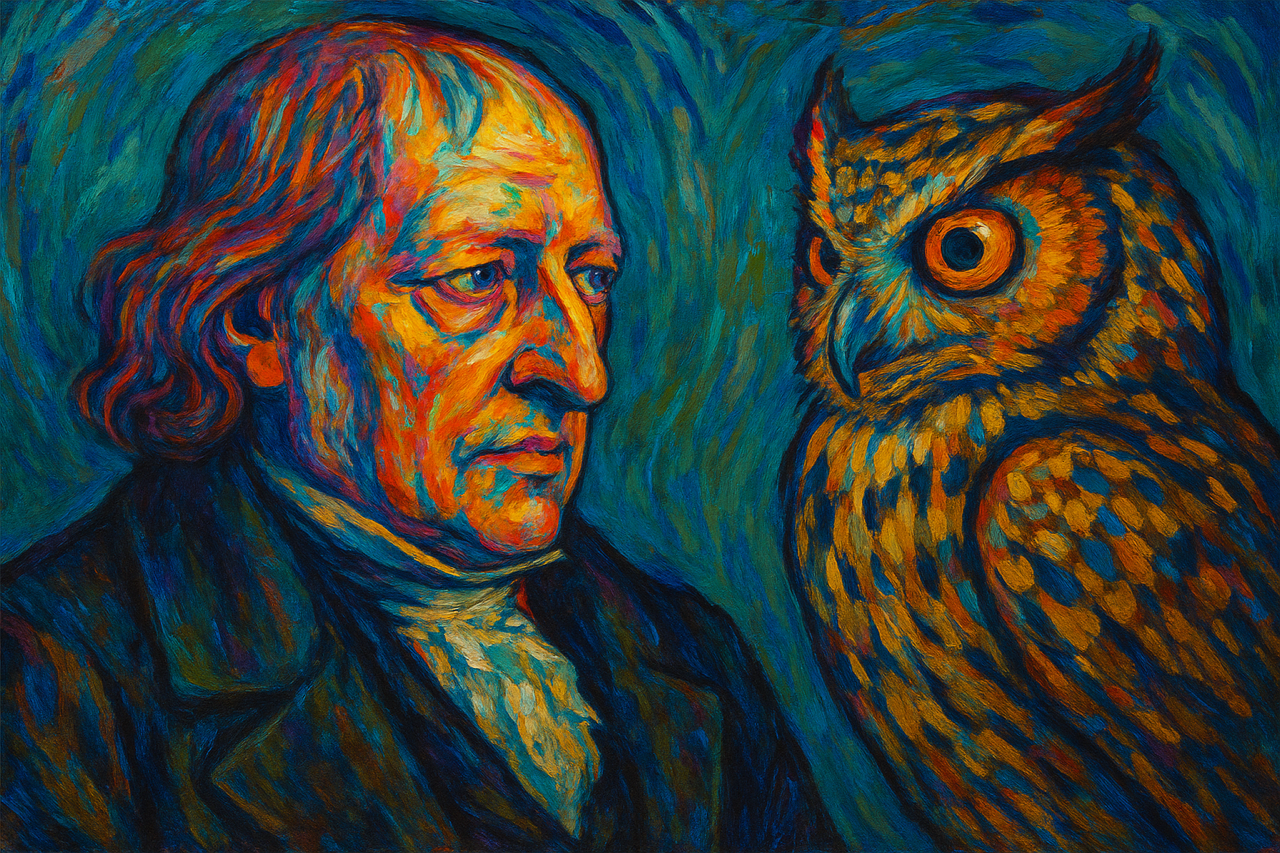
Long before the modern language of trauma, long before addiction treatment or the science of the nervous system, a German philosopher named Georg Wilhelm Friedrich Hegel sat at his desk in the early 1800s and tried to understand how truth unfolds in a human life. He lived through war, political upheaval, and the tremors of a world changing faster than people could make sense of it. His writing was dense and often misunderstood, and his critics were loud, but the influence he left behind was enormous.
Philosophers for the next century built their systems on his ideas. Marx, Kierkegaard, Nietzsche, Dewey, and even Wittgenstein were reacting to the ground Hegel had laid down. One idea of his stands tall above the rest: the truth of anything, especially a human life, can only be understood by seeing the whole of it.
Hegel had nothing to do with addiction. He never wrote about recovery. But he gave us a lens that fits our field like a key. He reminded us that every person stands on the shoulders of the dead. The laws we obey, the ideas we use, the institutions and sciences we inherit, even the language that shapes our minds, were built by people long gone. Their thinking still dominates us, silently structuring the world we walk through every day.
This is where Fellowship House begins.
With the understanding that no one lives in isolation.
We arrive inside a story already in motion.
Which means recovery must be viewed through the whole picture, not a fragment.
Holistic for us does not mean candles and buzzwords. It means taking the widest possible view of a person. It is the wide shot. The God-shot. The camera floating above the world, then descending slowly into the single human moment that needs care.
This is how we define recovery.
By refusing to reduce someone to a diagnosis or a moment.
By insisting that the truth of a person can only be understood by stepping far enough back to see the whole terrain.
Addiction makes more sense when we stop treating it as a flaw and start seeing it as an adaptation. A survival response to overwhelming fear. A nervous system pulled into fight, flight, or freeze long before the person had language for it. We are a modern civilization with Stone Age wiring. Our bodies still react as if we are running from predators, even while our lives are shaped by abandonment, food insecurity, humiliation, loneliness, grief, and despair.
When we zoom out, the story gets bigger.
We see that no one chose the environment they were born into.
We see the dead shaping our institutions, our punishments, our definitions of illness and health.
We see addiction as an understandable reaction to unbearable conditions.
And in that wider view, something liberating appears.
When someone arrives at Fellowship House, they carry narratives shaped by pain, neglect, or chaos. These stories have been held in shame for years, sometimes decades. But inside the safety of a structured environment like PHP, something shifts. They begin to see their past with objectivity instead of self-blame. They begin to understand that addiction was not a moral failure but an attempt to cope with overwhelming experiences.
Diagnosis has its place, but it cannot tell the whole truth.
If we rely on it alone, it compresses a life into a narrow lane.
It can even give someone an easy escape from responsibility.
But recovery that grows from the whole story offers something stronger. Accountability becomes empowerment rather than punishment.
You are not the victim of existence.
You are a participant in it.
You can learn to carry your story with strength.
You can develop resilience to pain instead of running from it.
You can become an active agent in your own future.
Some people discover this for the first time at Fellowship House. When safety and trust enter the room, the sealed chapters finally open. The painful story becomes speakable. The shame loses its charge. The truth becomes something you can hold without collapsing.
This is where recovery begins to breathe.
This is where wholeness takes shape.
In the awareness that truth lives in the whole.
In the understanding that a life is always larger than its pain.
In the courage to witness your story clearly and tell it without fear.
Fellowship House is built on this idea.
A holistic program for human beings, not diagnoses.
A place shaped by the wisdom of the living and the dead.
A place where the view is wide, the truth is whole, and the future becomes something you can shape with your own hands.
And at the end of this truth, something humbling appears. We stand on the dead. Their laws still guide us. Their science still defines us. Their models of the world are the architecture we walk into the moment we are born. To see this clearly is an act of humility. It is gratitude. It is the proper use of imagination.
It pulls us out of the tight, airless chamber of our own self-centered narrative and reminds us that we are not trapped in something. We are part of something. We arrived in a story of non-separation, a story already humming with meaning before we took our first breath.
This is the definition of connection we must seek.
Not the illusion of standing alone, but the truth of standing within.
The Dead Are Still Talking
Another Hegelian insight hits hard in the world of addiction treatment:
There is no clean separation between the living and the dead.
The dead wrote our laws.
They built our institutions.
They carved the grooves in our language.
They wrote the first definitions of addiction.
They built the first recovery programs and philosophies.
We inherit the world without being asked—its meanings, its defaults, its wounds, its opportunities.
Every time someone sits in a meeting and says “One day at a time,”
Wilson and Dr. Bob are speaking again.
Every time someone opens The Body Keeps the Score,
the thought-world of trauma researchers lives on.
And for us in our corner of Scranton,
the tradition of Richard Caron still breathes in the way we offer care, dignity, and a long runway.
Hegel would say:
You don’t get to start from scratch.
You begin inside a history—yours, your family’s, your culture’s, your community’s.
Your recovery grows out of the soil you didn’t choose.
References
Hegel, Georg Wilhelm Friedrich
• Phenomenology of Spirit (1807)
• Science of Logic (1812–1816)
• Encyclopaedia of the Philosophical Sciences (1817)
• Philosophy of Right (1820)
• Lectures on the Philosophy of History (posthumous)
• Lectures on Aesthetics (posthumous)
van der Kolk, Bessel
• The Body Keeps the Score: Brain, Mind, and Body in the Healing of Trauma (2014)
Alcoholics Anonymous / AA Literature
• Alcoholics Anonymous: The Big Book, 4th Edition (2001)
• Twelve Steps and Twelve Traditions (1953)
• As Bill Sees It (1967)
• AA Comes of Age (1957)
Additional Theoretical & Philosophical Works (Optional Supporting Sources)
• William James, The Varieties of Religious Experience (1902)
• Carl Jung, Modern Man in Search of a Soul (1933)
• Viktor Frankl, Man’s Search for Meaning (1946)
• John Dewey, Human Nature and Conduct (1922), influenced by post-Hegelian thought