

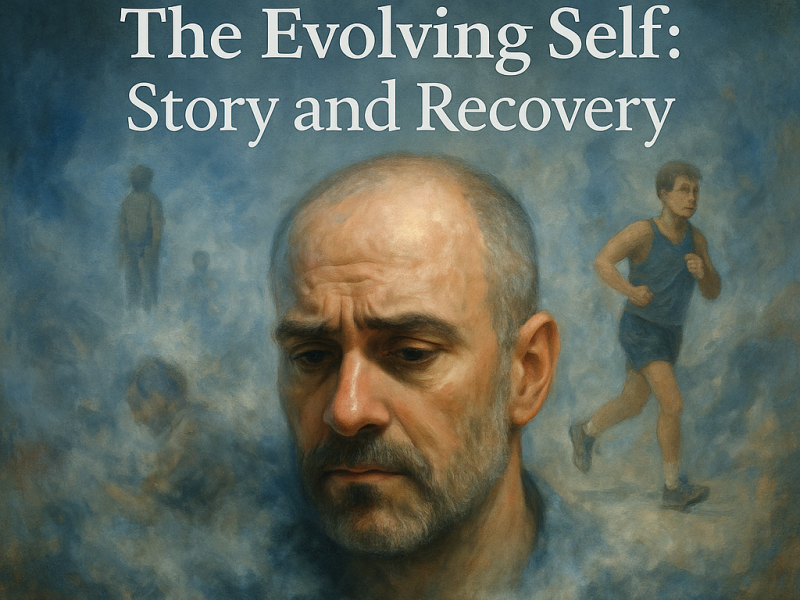
In recovery, we begin with a story.
Often, that story is told through fog—fragmented memories, comforting lies, and protective illusions that once kept us alive. We tell it anyway. We share it in meetings, therapy, or with a sponsor, and in doing so, we start to reclaim something. But what exactly changes as time passes?
Do the facts change? Or do we change?
The facts can shift. Not because events rewrite themselves, but because trauma, cognitive distortions, and the defense mechanisms we developed in active addiction start to break down. These protections served a purpose—to shield us from pain, shame, and vulnerability. But in early recovery, as clinical and communal support begins to land, that shield becomes porous. And through the cracks, insight emerges.
We revisit our story in middle recovery, and again in long-term recovery. Each time, we don’t just revise it—we relate to it differently. We start to see the flawed logic we applied to relationships, the harm we caused, the origins of our pain. Insight grows, and with it, something radical: self-awareness.
But let’s be honest—memory doesn’t function like a video file. It’s misty. It’s altered by emotion, by trauma, by the stories we’ve told ourselves to survive. In many people with substance use disorder, underdeveloped dopamine systems and impaired frontal lobe functioning mute accurate emotional regulation and warp our ability to weigh risk vs. reward. The result? Our story becomes reactive, self-protective, and delusional.
To truly recover, we need to begin the work of disclosure. Not for pity or punishment—but to become objective observers of our own story. Because that “dream machine”—that protective narrator that helped us survive—is always waiting to come back online. It doesn’t die just because we get sober. It evolves.
Real recovery builds resiliency. It doesn’t erase pain—it acknowledges it. That pain was the alarm we ignored, because the truth we needed to face stood in direct contradiction to the persona we built to survive in a world that often felt disconnected and unsafe.
Early recovery starts to crack that mask. But long-term recovery can dissolve it entirely—if we let it.
And in that space, we meet the deeper question: Who is telling the story? Is there a self behind the thoughts? Behind the identity?
Eastern traditions—and the Eleventh Step—suggest there is something beyond thought: awareness. A space where stories arise. Where “I” is just a point of observation, not a fixed identity. We are not our thoughts. We are not the worst things we’ve done, or even the best. Our thoughts arise in English, a language that’s not permanent, not universal, and not even static within our own culture. So what are we before language?
In that quiet space—through meditation, through step work, through presence—we begin to find it.
Bill Wilson saw it through Belladonna. Some see it through psychedelics. But most of us arrive at it through pain. Through sitting still. Through practicing the hardest kind of discipline: doing nothing.
And that is the door.
Recovery is not a return—it’s an arrival. Not a scripted identity, but a continuous unfolding. The self I was at 12, at 20, at 42—that self is gone. And thank God. There’s continuity in memory, but no need to live inside its prison.
The new script is awareness. The new story is unfolding. And the most radical truth in recovery is that you don’t have to be who you were.
You are not your next thought.
You are the space in which the next thought arises.
And that space—that awareness—is where recovery becomes real.
Mr WordPress
/ 11 Jun 2015Hi, this is a comment.
To delete a comment, just log in and view the post's comments. There you will have the option to edit or delete them.