

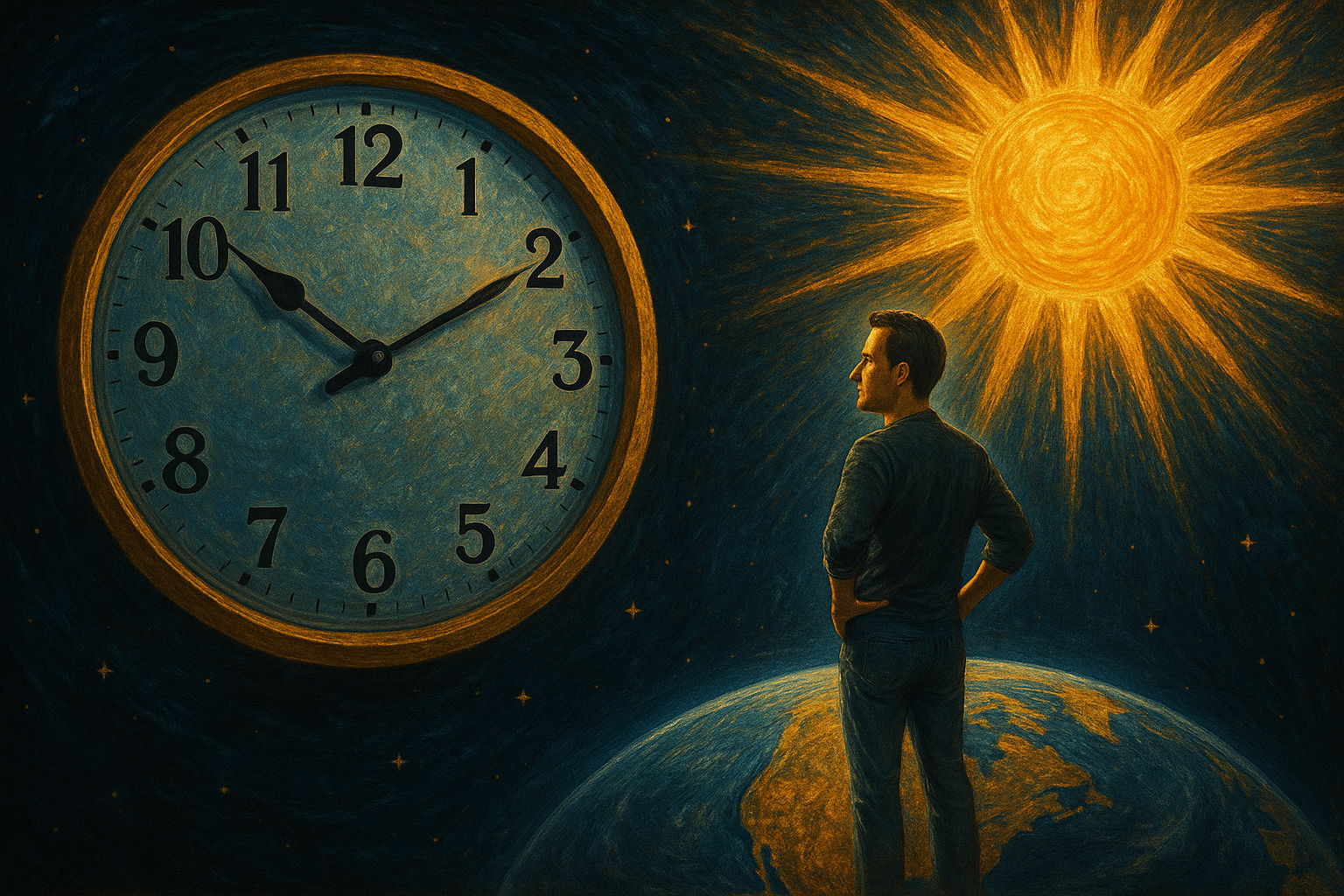
“One day at a time.” It sounds like a bumper sticker, a platitude passed around in church basements with burnt coffee. It is the recovery classic, whispered in panic, muttered in resignation, sometimes said with a laugh: you only have to stay sober today. But here’s the joke: today never really exists. By the time you say today, you are already in the next millisecond. Physics insists on the relativity of time, and cosmology reminds us that a “day” is nothing more than the Earth wobbling around our star. In fact, Earth’s rotation is slowing every year by a fraction of a millisecond. Stack enough “todays” and you don’t just have sobriety, you have the lifespan of a star.
“We live only in the present moment, but the present is so elusive we spend most of our lives ignoring it” (Tolle, 1999).
Time Before Language
Imagine Homo erectus. Did he worry about tomorrow’s debt collectors? Probably not. His time was immediate: weather, predators, hunger. Anthropologists argue that “temporal depth,” the ability to project far into past and future, comes only with the software of language (Deacon, 1997). When Homo sapiens appeared, equipped with more developed prefrontal cortices, myth and imagination entered the scene.
This was the decisive advantage. Neanderthals may have had bigger brains, but sapiens had stories. Stories about river gods, about what tomorrow might bring. Stories that gave cohesion, purpose, and survival advantage. But with the gift of conceptual time came the curse of rumination.
The Mind as a Time Machine
Joseph Goldstein, the American Buddhist teacher, likes to remind students that the mind’s great trick is pulling us into “past and future” movies, reels projected in the present moment (Goldstein, 2013). Neuroscience agrees: thoughts are electrical events in the now, firing networks that create emotion, and emotion creating behavior.
That breakup from three years ago? Still running in Dolby surround while you’re sitting in a PHP group in Scranton. That imagined relapse tomorrow? A phantom. The only place either exists is now.
“All that is ever known, all that is ever experienced, is the present moment” (Goldstein, 2013).
The Theft of Now
Alcoholics Anonymous (1939/2001) insists that insanity is confusing the true from the false. In early sobriety, that insanity often looks like living in two non-existent places: the regret-soaked past or the anxious future. Both are theft, stealing the only currency existence ever offers: presence.
Eckhart Tolle (1999) sharpened this axiom: there is no future, only the thought of it. Anxiety is a kind of “psychosis light,” a hallucination of tomorrow acted out today.
East Meets West
Buddhism calls this recognition sati—mindfulness, remembering the present. Step 11 of AA echoes: “sought through prayer and meditation to improve our conscious contact.” Both point to the same experiential physics: consciousness is always arriving now.
From a physics lens, relativity tells us that “now” is not even universal. Clocks on mountaintops tick faster than clocks at sea level (Einstein, 1916). Yet for any given conscious mammal, all perception funnels into one point. The trick is not to freeze it or stretch it, but to simply recognize: you never leave it.
Even Christ, in one of his final paradoxes, said to the thief beside him: “Today you will be with me in paradise” (Luke 23:43). He linked today with eternity. That eternity is not some far-off place but about to be experienced today. It is the same paradoxical truth found in Buddhism: eternity is not a future event, it is always now.
Practice and Freedom
“One day at a time” is not just an AA cliché. It is a cosmic fact wrapped in homespun wisdom. To live aligned with now is to release the psychodramas of past and future, to see trauma for what it is: a vivid dream the body still believes.
Goldstein calls this “the practice of seeing the movie for what it is” (2013). AA calls it “restoring sanity.” Physics calls it entropy always unfolding in the present.
The truth is, you will only ever find yourself in one place forever. Now. And in this truth, you only experience life and life. It is not life and death. Yes, we may experience loss, but if you are living in the now, you can only experience life. Death never arrives.
And if you can laugh at that? Congratulations. You’ve found spirituality.
References
• Alcoholics Anonymous. (2001). Alcoholics Anonymous: The story of how many thousands of men and women have recovered from alcoholism (4th ed.). Alcoholics Anonymous World Services. (Original work published 1939)
• Deacon, T. (1997). The symbolic species: The co-evolution of language and the brain. W.W. Norton.
• Einstein, A. (1916). Relativity: The special and the general theory. Henry Holt.
• Goldstein, J. (2013). Mindfulness: A practical guide to awakening. Sounds True.
• Tolle, E. (1999). The power of now: A guide to spiritual enlightenment. New World Library.
• The Holy Bible, Luke 23:43 (New International Version).