

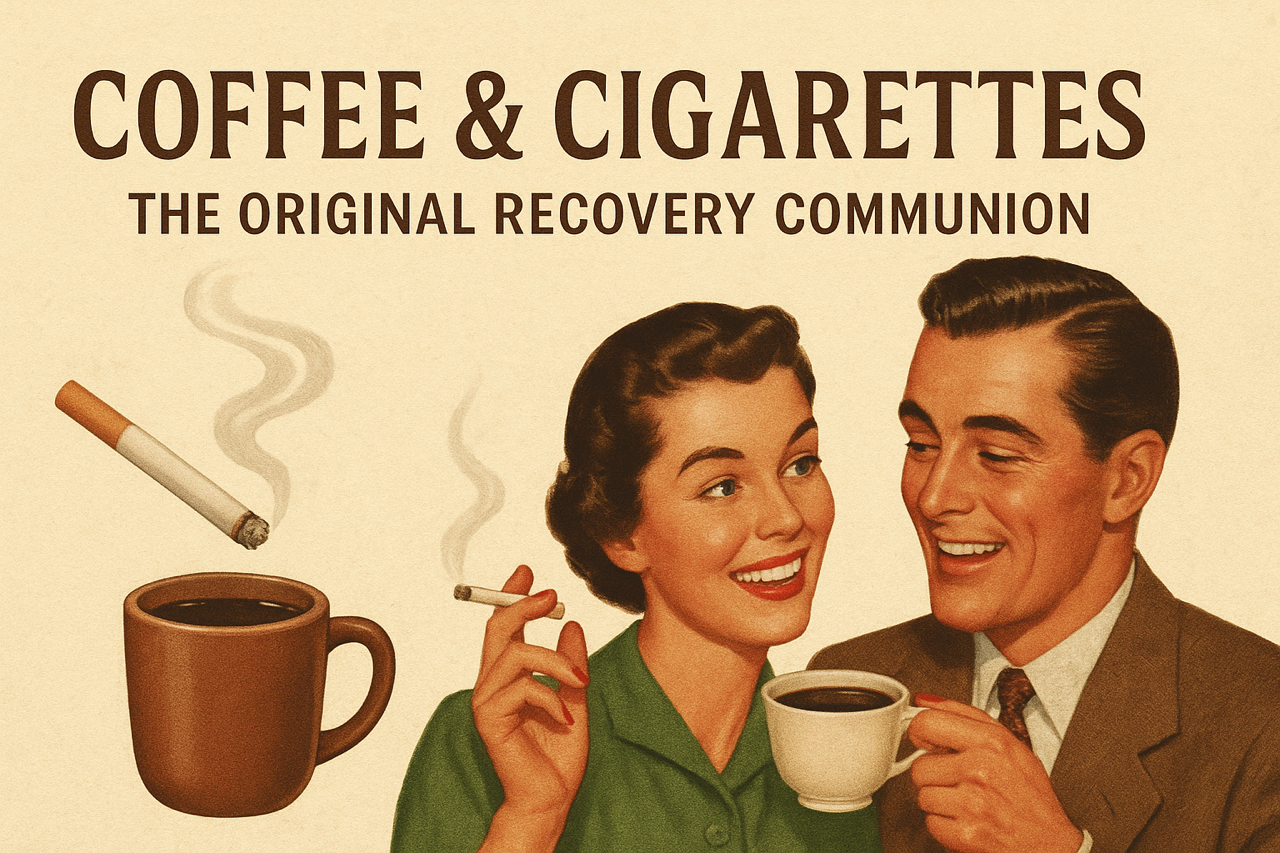
There’s a peculiar grace in the pairing of coffee and cigarettes — a slow, smoky liturgy that once marked the sacred spaces between meetings, detoxes, and halfway-house back steps. For many in recovery, it was the first socially acceptable ritual that didn’t lead straight to ruin. A bitter cup, a burning stick, and suddenly you weren’t alone anymore. You were part of the congregation — jittery, talkative, raw, alive.
In early recovery, the world shrinks to what you can handle. Coffee and cigarettes are the training wheels of living again — mild addictions that let you still feel a pulse without wrecking your life. They are tiny rebellions, sanctioned sins, proof that the dopamine faucet hasn’t completely rusted shut.
The Origins Of A Pair
When Alcoholics Anonymous took root in mid-century America, meetings were often clouded in literal smoke. A fresh pot brewed, a dozen ashtrays overflowing. The sensory landscape of recovery smelled like Maxwell House and Marlboros. It wasn’t just habit — it was communion. People stood outside after the meeting, talking longer than they had in years, flicking ash as they flicked off their masks. Recovery was gritty, tactile, and alive.
The Reality Beneath The Ritual
Yet the romance of smoking has always been built on a lie — a masterclass in manipulation that began a century ago. The lie had a name: Edward Bernays, Sigmund Freud’s nephew and the father of modern public relations. Bernays used his uncle’s insights into the unconscious to sell everything from soap to war, and in the 1920s, he helped sell cigarettes to America.
He branded smoking as liberation — “torches of freedom” for women — and later convinced doctors to endorse them. Industry scientists engineered cigarettes so that the withdrawal began almost immediately after a few drags. Packs came in twenties not by accident, but design — each cigarette feeding the cycle of relief and craving in perfect rhythm. The “calm” of smoking was nothing more than the easing of withdrawal — the great lie of nicotine: you’re not relaxing; you’re just stopping the pain it caused.
Bill Wilson, the co-founder of Alcoholics Anonymous, knew this all too well. He couldn’t put them down, and like so many heroes of our grandparents’ generation — Yul Brynner, John Wayne, the Marlboro Man — he died of lung disease. The nostalgia we feel for that smoky past isn’t harmless. Behind all nostalgia hides a myth, a gentle deception that comforts us into continuing what we know makes no sense.
And yet — in early recovery — coffee and cigarettes are the OG of harm reduction. They are the last bridge between chaos and discipline, between hiding and belonging. The ember between two fingers was a lighthouse in the fog for countless newcomers.
The State and The Smoke
It was like being asked where the confessional goes. In 2025, it’s the last relic of behavioral health’s wild frontier — the state still insisting you designate a smoking area. There’s something hauntingly beautiful about that. The last outlaw ritual still recognized by law.
Because for many of us, those smoky porches and picnic tables were where the real work got done — where Step One cracked open, where resentment met laughter, where you realized your story wasn’t unique but it was still holy.
Why It Endures
You could call it irony. You could call it evolution. I call it a gentle truce with the beast — a smoky peace treaty that lets us stand in the cold with each other, just long enough to remember we’re still alive.
Now we sip to remember.
And sometimes, that remembrance smells like burnt coffee and a cowboy killer at dawn.