

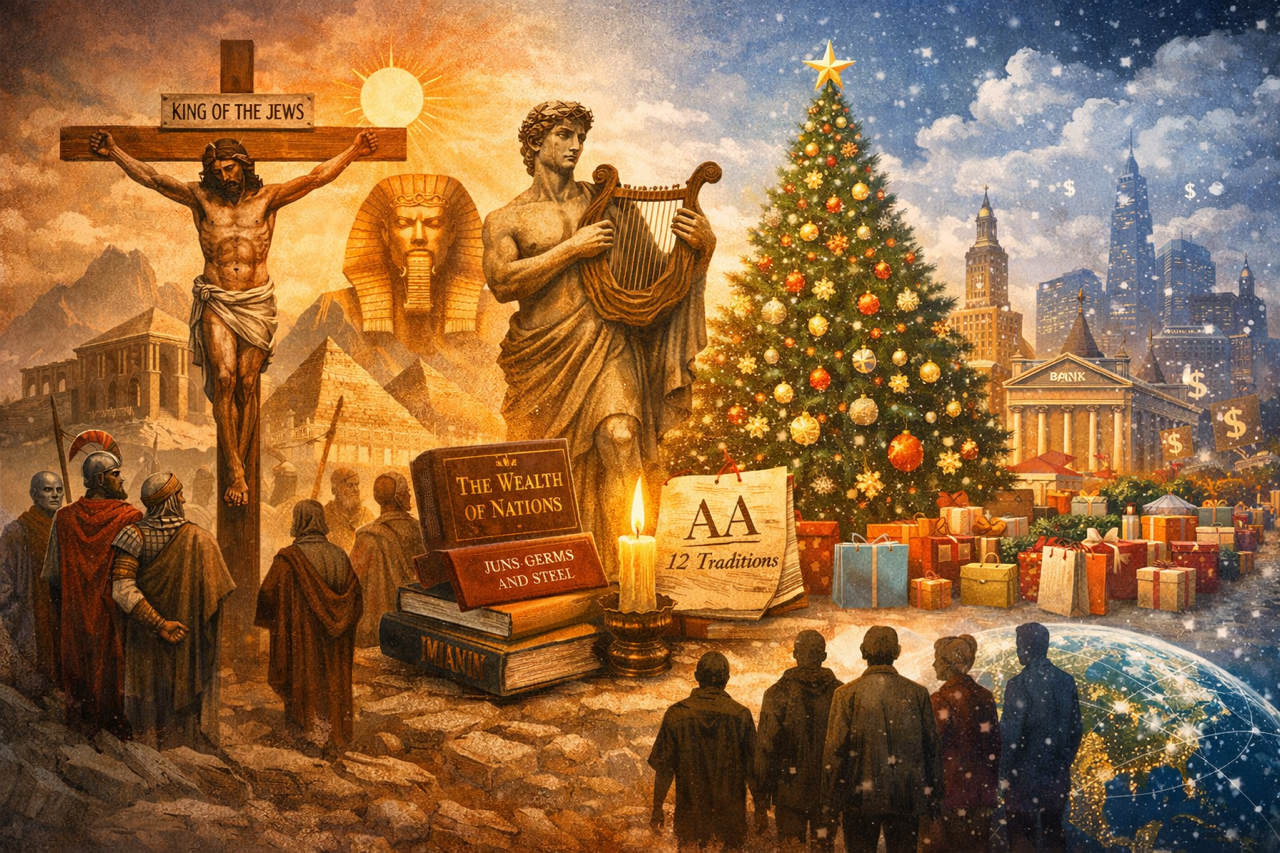
I was raised Catholic, shaped by Christian principles, ritual, and moral language. I learned early the logic of sin and absolution, the centrality of sacrifice, and the ancient idea, shared well beyond Christianity, that human sacrifice or deicide was the pathway to redemption. A life offered to repair a moral rupture.
I no longer identify as Christian.
What I am is someone with forty seven years of observing Christmas, its theology, psychology, politics, and contradictions. I am not interested in suspending my critical faculties or pronouncing articles of supernatural faith I do not hold. Still, I continue to learn from Christmas.
That matters.
Because dismissing Christmas outright would be as lazy as swallowing it whole.
The Bronze Age still has lessons to teach us, not because its cosmology was correct, but because its experiments with power, agency, sacrifice, and truth are still running in the background of modern life. Christmas is one of the longest running of those experiments.
What follows is not belief.
It is observation.
The New Covenant and the Question of Kingship
So we see Christ arrive as the so called new covenant. But the real question, historically and psychologically, is not whether he is called king, but what kind of king he is.
A king of whom?
Not landowners.
Not armies.
Not bloodlines.
He is described as king of the misanthropes, the misfits, the abandoned, the disparaged, and the meek. Meek not as weak, but as voiceless and without representation. This is a radical idea emerging just after the Bronze Age, when power meant force, lineage, and myth protected authority.
Most ancient civilizations understood rule this way. Egypt is the cleanest example. The pharaoh was divine, equivalent to Ra. Myth protected power. To question the ruler was to fracture the cosmos.
Then something unusual appears in the Hebrew tradition.
David, flawed, violent, adulterous, is still written about honestly. The record does not protect the king’s image. This is one of the earliest cultural commitments to the idea that truth about leaders matters more than the myth of leaders. A proto journalistic ethic embedded inside religious text.
By the time we reach Jesus Christ, that ethic becomes a public spectacle. King of Kings is not merely a title. It is mockery. The crucifixion is anti monarchy theater. A crown of thorns, authority without force, sovereignty stripped of violence.
Whether one believes in divinity or not, the inversion is undeniable.
Breaking the Monarchy as a Moral Ideal
Most dominant religions still imagine the universe as a monarchy. God as king. Heaven as court. Authority flowing downward. But the Christmas narrative introduces a rupture.
This king serves.
This king refuses domination.
This king represents those crushed by systems they did not design.
And that is dangerous.
Tyrants have always understood something uncomfortable. Many humans do not actually want agency. They want certainty. They want binaries. They want someone else to decide.
Two teams. One winner. Sunday afternoon relief from choice.
True agency is not rebellion. That is merely inverted obedience. It is the capacity to tolerate uncertainty, to act without mythic cover, to choose without guarantees.
That psychological capacity is the foundation of democracy.
From Christ to Republic and Back Again
The Greeks attempt democracy. The Romans refine representation. Later, Rome converts to the Holy Apostolic Roman Church, preserving monarchy in heaven while experimenting with law, consensus, and delegation on earth.
Power becomes something you loan, not inherit.
This evolution is fragile. Under stress, economic, cultural, existential, societies regress. We lean back toward strongmen who promise to decide for us, to rescue us from ambiguity, to solve complexity.
This is not new.
It is a recurring human pattern.
As Jared Diamond argues in Guns, Germs, and Steel, geography, resources, and social organization, not moral superiority, shape civilizations. Democracies do not arise because humans become virtuous. They arise because distributed power scales better than domination under certain conditions.
When those conditions fracture, myth rushes back in.
The Refusal That Becomes A Republic
There is a moment where this ancient idea crystallizes into modern political reality.
George Washington could have been king. This was not metaphor. It was discussed openly and seriously. He had the army, the legitimacy, the cultural reverence, and a population exhausted enough to accept monarchy if it promised stability.
And he refused.
He returned power.
He stepped away.
He made leadership temporary.
In doing so, Washington enacted the same inversion introduced centuries earlier. Authority is not something you seize and keep. It is something you hold briefly, humbly, and conditionally.
Ken Burns’ documentary The Revolutionary War captures this with quiet clarity. The revolution was not inevitable. It could easily have collapsed into another dynasty. It survived not because Americans were uniquely virtuous, but because certain individuals resisted the oldest human temptation.
Power wanted permanence. Washington chose restraint.
This refusal mirrors the earlier narrative stripped of theology. A leader offered dominion who declines consolidation. A republic born not just from rebellion, but from the disciplined refusal to become what was overthrown.
That refusal is fragile. It must be relearned each generation.
Capitalism and the Adoption of Christmas
Capitalism did not destroy Christmas. It recognized its utility.
Adam Smith understood this long before modern marketing. In The Wealth of Nations, Smith describes markets as moral ecosystems that require trust, norms, and restraint to function. Markets do not generate virtue on their own. They consume it.
Christmas becomes capitalism’s moral theater.
Consumption dressed as generosity.
Loneliness acknowledged once a year.
Cooperation rehearsed briefly at scale.
It spreads everywhere, Christian, Muslim, secular, authoritarian, not because of theology, but because symbolic generosity lubricates large systems.
Capital speaks where ideology fails.
Recovery, AA, and the Anti Monarchical Model
In 1955, something quietly radical happens again.
Alcoholics Anonymous formalizes its Twelve Traditions. One of the most functional anti authoritarian governance documents in modern history.
No leaders, only trusted servants.
Autonomy without fragmentation.
Authority without domination.
Each group is autonomous, except in matters affecting AA as a whole.
It mirrors early Christian communities.
It mirrors functional democracies.
It works for the same reason.
Recovery, like liberty, cannot be imposed.
The Lucifer Principle & The Temptation of Power
Howard Bloom’s Lucifer Principle frames evil not as individual pathology, but as group dynamics that reward domination. Hierarchies amplify aggression. Alpha systems metastasize under stress.
Christmas, stripped of myth, still resists this impulse. It centers vulnerability. It elevates service. It insists that power is accountable to the powerless.
That insistence never disappears. It only recedes.
The Quiet Liberty of Obedience
Here is the final paradox.
Liberty is not the absence of rules.
It is obedience to laws we agree upon, with the humility to change them when they fail.
That obedience is not submission.
It is participation.
And maybe that is the secular heart of Christmas.
Not a king who conquered,
but a king who refused to dominate,
and asked humans to grow up enough to choose.
References and Anchors
• The Wealth of Nations
• Alcoholics Anonymous, The Twelve Traditions (1955)
• Hebrew Bible, Books of Samuel, Davidic historical accounts
• New Testament, Synoptic Gospels, Nativity and Passion narratives
• Guns, Germs, and Steel
• Bloom, Howard. The Lucifer Principle
• George Washington, resignation of military command and refusal of monarchy
• The Revolutionary War
• Roman Saturnalia and early Christian syncretism scholarship on the evolution of Christmas