

One of my favorite concepts in addiction treatment is a term called recovery capital.
It’s taught throughout the substance use disorder field, appears in modern recovery literature, and is included in Pennsylvania DDAP educational materials. The idea is straightforward: people do not recover on willpower alone. They recover because they possess, or learn to build, assets that support recovery.
The word itself is fascinating.
Capital is usually associated with economics. We think of money, investments, businesses, and wealth. But capital is a much broader idea than dollars.
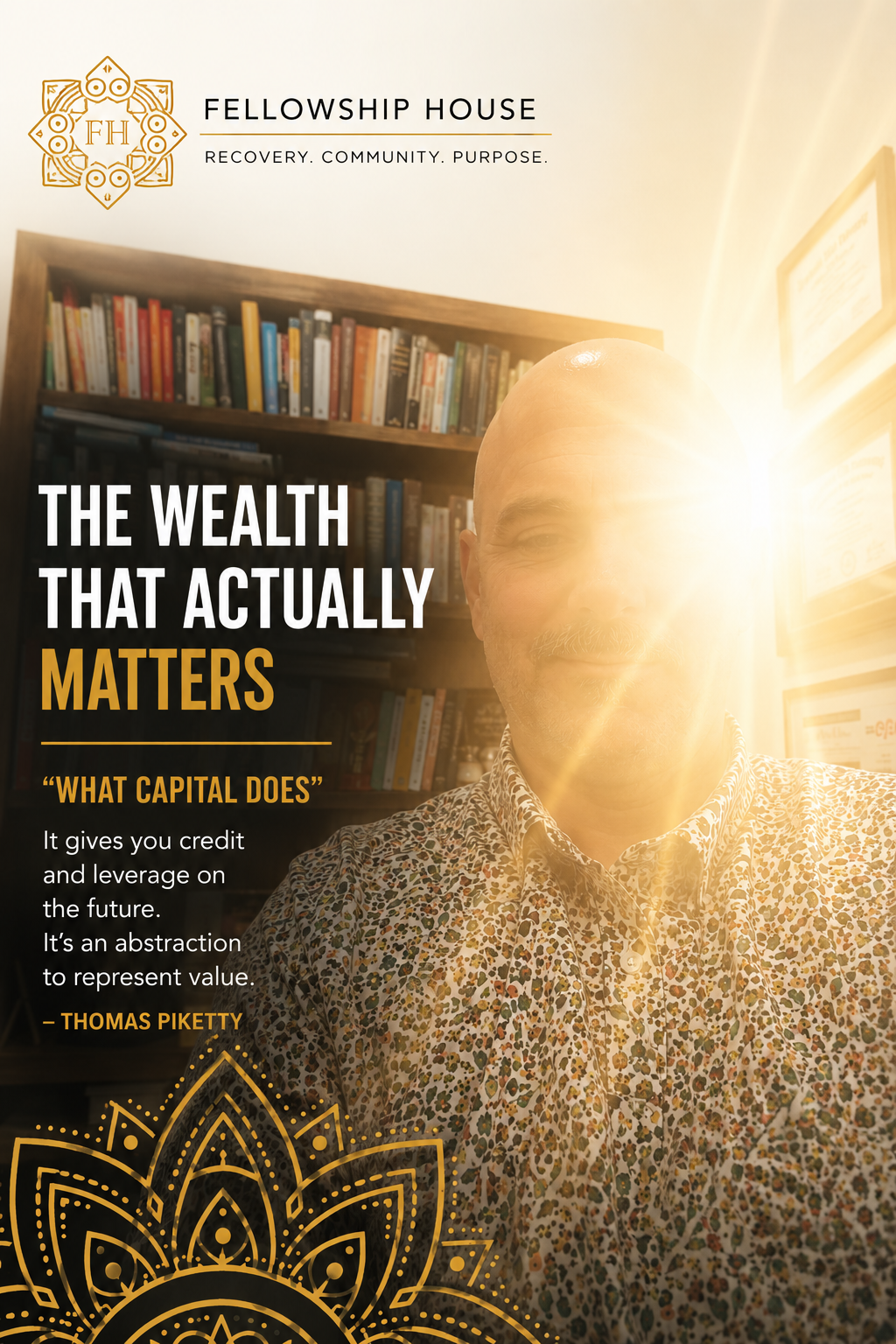
Economist Thomas Piketty, in Capital in the Twenty-First Century, describes capital as accumulated assets that generate future benefits. Capital allows individuals, families, organizations, and societies to carry value forward through time. It provides leverage on the future. It creates options, opportunities, and resilience.
Money is one form of capital.
Education is another.
Skills are another.
Relationships may be the most important form of all.
Capital, at its core, is an abstraction. It is a word we use to represent something valuable that can influence future outcomes.
That is why I have always loved the term recovery capital.
Recovery capital asks a powerful question:
What valuable resources already exist in a person’s life that can support long-term recovery, and what resources need to be built?
When we look through this lens, the conversation changes.
Instead of asking, “What’s wrong with this person?”
We begin asking, “What strengths, supports, opportunities, and relationships can help this person flourish?”
Recovery capital can include:
• Safe housing
• Employment opportunities
• Family support
• Friendships
• Mentors and sponsors
• Recovery meetings
• Transportation
• Education and job skills
• Physical health
• Spiritual practices
• Community involvement
• A sense of purpose
Every one of these assets increases the likelihood of sustained recovery.
Every one of them becomes a form of wealth.
At Fellowship House, we spend a great deal of time helping clients identify their existing recovery capital and build new forms of it. Sometimes people arrive believing they have none.
Then we begin taking inventory.
A supportive grandmother.
A former employer willing to give another chance.
A recovery meeting that feels welcoming.
A sponsor.
A church.
A trade skill.
A talent.
A dream that has not completely died.
Suddenly the picture changes.
Recovery becomes less about avoiding drugs and alcohol and more about accumulating assets for a meaningful life.
One of the reasons Northeastern Pennsylvania has such a special recovery community is because recovery capital is everywhere once you begin looking for it.
Scranton and Lackawanna County remain places where relationships still matter.
People show up for each other.
Employers take chances on people.
Recovery houses create fellowship.
Meetings happen every day.
Alumni stay connected.
Families heal.
A newcomer can arrive with very little and discover an entire ecosystem of support.
Not because anyone is dependent on it.
Because they are invited into it.
Because they are offered an opportunity to build a new life.
In a culture increasingly mediated through screens, algorithms, and digital identities, it is easy to forget what creates genuine wealth.
Unplug for a little while.
Look around.
The deepest forms of capital have always been relational.
Trust.
Belonging.
Friendship.
Purpose.
Love.
These are not abstract concepts. They are among the most valuable assets a human being can possess.
As clinicians, we often use words without stopping to define them. Yet language matters. A good clinician takes the time to tether words to reality.
Recovery capital is more than a technical term.
It reminds us that recovery is not merely the absence of drugs or alcohol.
Recovery is the accumulation of resources that make a good life possible.
And perhaps there is something spiritual hidden in that realization.
Not magical spirituality.
Not something distant or supernatural.
Something available right here.
The moment we begin paying attention to the relationships, opportunities, and acts of service surrounding us, the noise starts to fade.
The world becomes visible again.
We discover that the greatest wealth was never financial.
It was always found in connection.
The opposite of addiction is not simply abstinence.
It is recovery capital.
Relationships, purpose, trust, and belonging accumulated over time, creating a future worth staying sober for.
References
Best, D., & Laudet, A. (2010). The Potential of Recovery Capital. London: RSA.
Cloud, W., & Granfield, R. (2008). Conceptualizing recovery capital: Expansion of a theoretical construct. Substance Use & Misuse, 43(12-13), 1971-1986.
Granfield, R., & Cloud, W. (1999). Coming Clean: Overcoming Addiction Without Treatment. New York University Press.
Piketty, T. (2014). Capital in the Twenty-First Century. Harvard University Press.
White, W. L., & Cloud, W. (2008). Recovery capital: A primer for addictions professionals. Counselor Magazine, 9(5), 22-27.
Pennsylvania Department of Drug and Alcohol Programs (DDAP). Addictions 101 Training Materials and Recovery-Oriented Systems of Care Resources.