

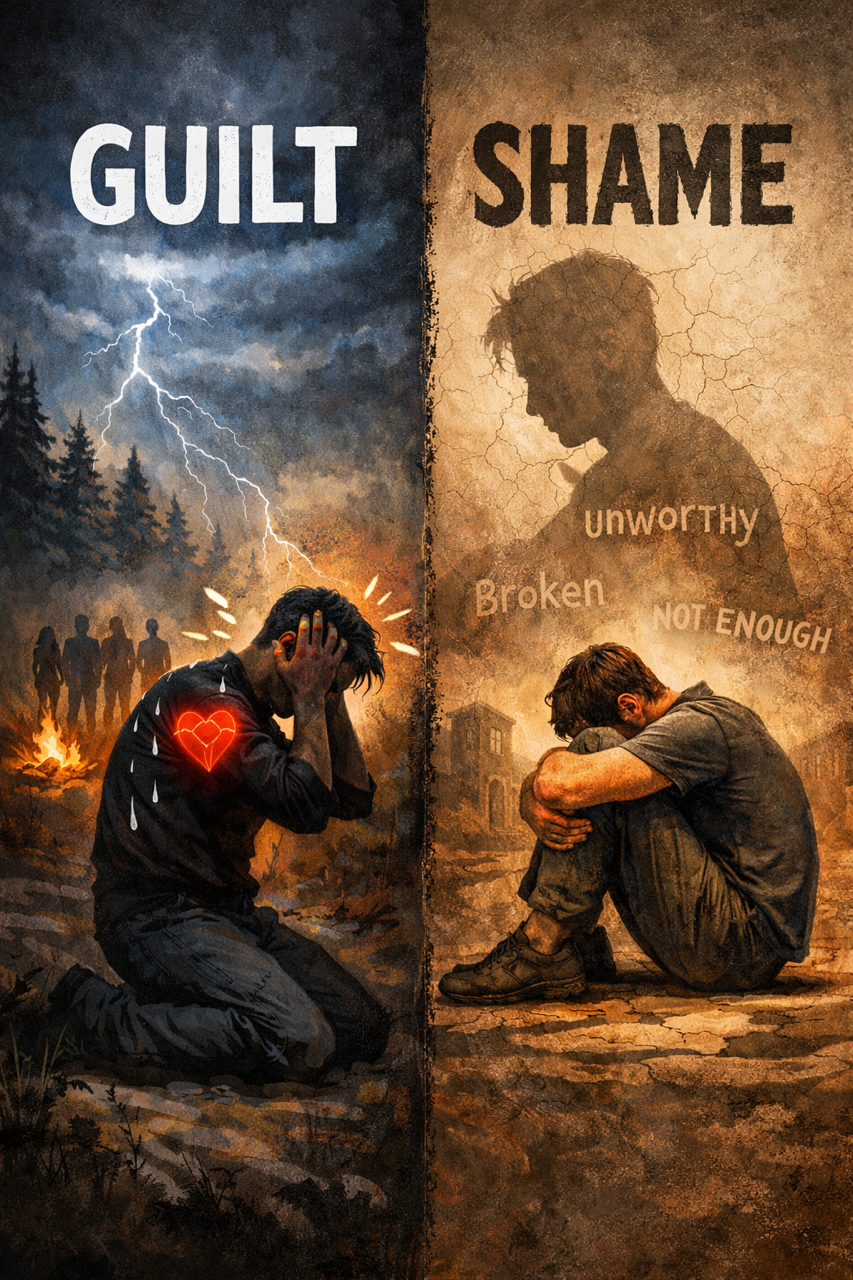
Guilt is an emotion.
Shame is a belief.
That distinction matters more than it sounds.
Guilt arises in real time. It is the body’s response to misalignment, when something we have done violates a value, a rule, or an agreement we believe in. It is uncomfortable by design. The heart rate shifts. Breathing tightens. The face gives us away before we finish the thought. Guilt is ancient, social, and corrective. You see it in primates, in pack animals, in early human groups where deception threatened survival. Guilt says something happened and it needs repair. It assumes there is still a self worth returning to the group.
Shame is something else entirely.
Shame is not about what you did.
Shame is about who you believe you are.
I was born in 1978. By then, the Western world was roughly 250 years into capitalism, long enough for The Wealth of Nations to mature into something resembling a civic religion. One that could sit neatly on top of older theologies like Christianity, Judaism, and Islam. In the West, economic success had begun to function as absolution. It did not replace morality. It floated above it.
My early education began under the Holy Roman Apostolic Church. I was taught the virtues of a strange and compelling rabbi who valued meekness, humility, and care for the marginalized. I was taught rules that were clear, rigid, and moral. With a hyperactive nervous system and a restless mind, those rules were hard to follow. I often knew when I was misaligned. I felt guilt. I was punished. That part made sense.
But there was something else in the air.
Beneath the theology, there was an unspoken hierarchy suggesting the moral rules were real but conditional. They were toys we could play with until status entered the room. Once wealth and socioeconomic power arrived, the rules seemed to bend or disappear. The world appeared to forgive certain people faster than others, not because they were more virtuous, but because they were more valuable.
That was the shame that got downloaded early. Not through doctrine, but through observation.
The message was not you did something wrong.
The message was you are positioned wrong.
Until you achieved something measurable, money, success, recognition, you were provisional. You could be liked, but lightly. Included, but not fully. Entertaining, perhaps. But not equal. Belonging was something to be earned later.
Guilt came from violating moral rules in catechism.
Shame came from believing I was beneath the system itself.
And worse, I learned, at least in my own perception, that once you succeeded, the moral rules would change for you. That success did not just bring comfort, it brought immunity. The world would validate you regardless of how you got there. Until then, you should feel bad about who you are, because your experience of life would be smaller and less protected.
That belief stayed lodged far longer than any theology.
Shame is what happens when an alarm system stays on too long. When unresolved stress, comparison, and powerlessness turn into identity. The brain stops asking what happened to me and starts insisting this is who I am. Shame thrives because it feels rational. It masquerades as insight. It claims to be truth.
What collapsed that belief was not success, ironically, but scale.
When you zoom out far enough, the story changes. You stop seeing yourself as defective and start seeing a species improvising. Capitalism was not handed down from the heavens. It was a tool. A powerful one. It scaled us to libraries, clean water, education, medicine, and longer lives. It also distorted value, confused worth with output, and taught us to rank humans as assets.
Once you see that, you are no longer trapped inside your personal narrative. You can return to values that are older and more stable than any economic apparatus. Honesty. Care. Responsibility. Restraint. Repair. Virtues that predate markets and will outlive them.
From there, something loosens.
Guilt becomes useful again.
Shame loses its authority.
You no longer need to sit beneath economics, waiting for permission to be whole. You can sit above it, participating without worshiping, succeeding without mistaking success for worth.
And in that space, life gets quieter.
More connected.
Less performative.
Not because you finally earned your place, but because you never had to.
References and Further Reading
Tangney, J. P., and Dearing, R. L. (2002). Shame and Guilt. Guilford Press.
Foundational work distinguishing guilt as behavior-focused and shame as identity-focused.
Gilbert, P. (2009). The Compassionate Mind. New Harbinger.
Explores shame as a threat-based system linked to social rank and survival.
Sapolsky, R. (2017). Behave: The Biology of Humans at Our Best and Worst. Penguin Press.
Provides evolutionary and neurobiological grounding for moral emotions and social regulation.
Bowlby, J. (1988). A Secure Base. Routledge.
Connects shame and self-concept to attachment, safety, and early relational experience.
Smith, A. (1776). An Inquiry into the Nature and Causes of the Wealth of Nations.
Historical context for the rise of economic value as a dominant organizing principle.
Brown, B. (2012). Daring Greatly. Gotham Books.
Popular but useful synthesis on shame, vulnerability, and cultural reinforcement.