

When I was sixteen, I found myself in a reformatory boot camp, South Mountain, Pennsylvania. It was a strange place to end up for a kid who liked oil painting, pot smoke, and the music of the sixties and seventies. Overnight, I was stripped of all that. My head was shaved. I was woken at 3 a.m. to pull on a poncho and search for holes in the shower tiles, preparing for rain that might never come.
There was no therapy there, no treatment, no clinical insight. “Clinical” meant push-ups or the Bible. The Old Testament, mostly, Bronze Age morality, the language of punishment and obedience. The men who ran the place were Airborne Rangers, half-drill sergeant, half-priest. Their emblem was a stick figure pushing a rock up a hill.
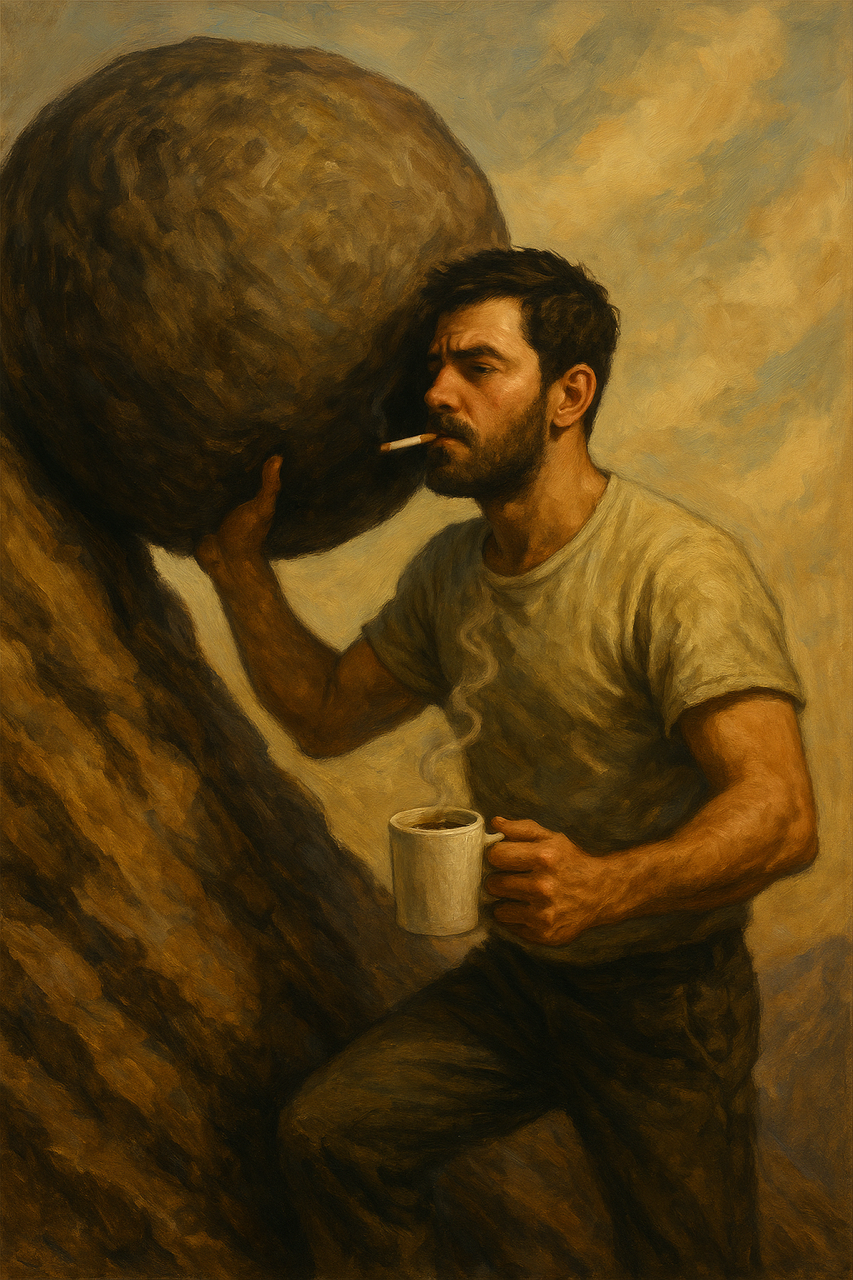
I recognized it right away. I was already familiar with Greek mythology, and there he was—Sisyphus. The only lens I had then was a punitive one: a slick king, willful, deceitful, a kind of prototype for the modern Western politician, condemned to roll his pride uphill forever.
I found myself in an environment with no room for abstraction, irony, or poetry. There was a version of me that had to retreat far into a locked room inside my head, because the world around me was made of atoms and those atoms were controlled by psychotic adults. Any trace of humor, any act of resistance, was met with violence.
That image of Sisyphus burned into me. I saw it as a symbol of domination, of breaking boys into obedient men. But years later, through Albert Camus’ The Myth of Sisyphus, I began to see it differently.
The Absurd and the Hill
Camus saw in Sisyphus the story of consciousness itself, the endless, absurd effort to create meaning in a world that offers none. “The struggle itself toward the heights is enough to fill a man’s heart,” he wrote. “One must imagine Sisyphus happy.”
In boot camp, Sisyphus was punishment. In recovery, he’s become something else, a reminder that meaning isn’t handed down by gods or systems or even therapists. It’s chosen, one small, deliberate act at a time.
Breaking and Rebuilding The Self
Back then, I saw that “break them down to build them up” model everywhere, from military training to drug treatment to religion. It was the same pattern: dominate the mind, crush the ego, rebuild obedience.
But the problem is, who’s doing the rebuilding? What’s left after the demolition? If the self is destroyed, who’s left to recover?
Sisyphus shows the cruelty of that logic: an eternal workload with no creativity, no novelty, no freedom. Just repetition. A punishment born not of evil, but of absurd loyalty to a system that confuses control for care.
From Futility to Awareness
Over the years, I’ve realized there’s another way to read Sisyphus. In Step 11 of recovery, through Vipassana meditation, I’ve begun to see the hill as consciousness itself. The boulder isn’t punishment. It’s awareness.
In high-dose psychedelic journeys, and in the quiet observation of breath and body, I’ve seen that consciousness is an event, just one endless now, full of sensory data, stitched together by the mind into the illusion of a linear self called “Joe Van Wie.”
Camus said the alternative to this absurdity is nothingness. Death. So we choose the hill. We choose to push. But if we push with awareness, we might notice the weight of the stone, the sound of gravel, the pulse in our chest. That’s life. That’s where meaning lives.
When Sysiphus Sets The Rock Down
Still, I wonder, what happens if Sisyphus stops pushing? What if he decides the gods don’t own his hill anymore?
That’s where my struggle lives now. Watching cruelty and polarization in public life, I sometimes want to walk away from the hill. But then I remember, boredom is not a property of the world; it’s a symptom of the mind. When I meet the world with awareness, even the ordinary becomes strange, alive, and novel again.
Camus once said, “Should I kill myself or have a cup of coffee?” That was his shorthand for choosing life, however absurd it feels. I’ve chosen the coffee, and through recovery, that choice has become richer, layered with compassion, service, and humor.
Pain, I’ve learned, is real. But it’s also communication. It’s how we connect to others, to their loneliness, to their longing. And when we meet that pain without judgment, something changes. The absurd becomes sacred. The hill becomes home.
In The End
Recovery, like Sisyphus’ climb, is an eternal act of beginning again. The rock never disappears; it just becomes lighter as we learn to notice it. The real punishment isn’t in pushing; it’s in forgetting why we push.
Today, I push the rock differently. Not to atone, or to prove, or to be remade, but to stay awake. To stay curious. To keep choosing the cup of coffee.
References & Suggested Readings
- Camus, A. (1942). The Myth of Sisyphus
- Nietzsche, F. (1887). On the Genealogy of Morality.
- Goenka, S. N. (1992). The Art of Living: Vipassana Meditation.
- Alcoholics Anonymous. (1939). The Big Book. Step Eleven.